About:
Unproven, Unlikely and Firmly Believed: Why We Fall for History's Most Seductive Conspiracy Theories, and How We Rediscover Reality by Jonn Elledge and Tom Phillips examines human gullibility when it comes to massive following of conspiracy theories, Misters Elledge and Phillips are British journalists and authors.
- 352 pages
- Publisher : The Experiment
- Language : English
- ISBN-13 : 979-8893031508
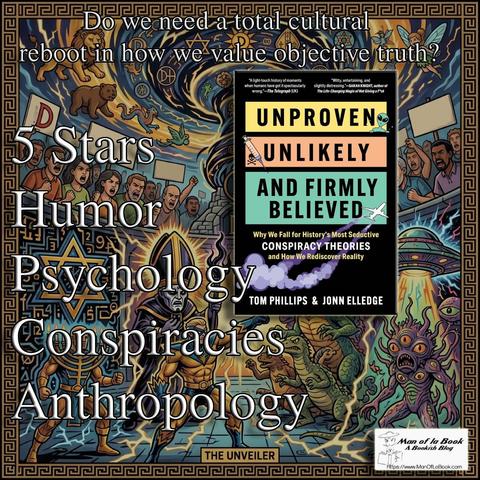
My rating for Unproven, Unlikely, and Firmly Believed - 5
Buy Unproven, Unlikely, and Firmly Believed from Amazon.com*
More books by John Elledge*
More books by Tom Phillips*
Thoughts:
This book has cought my eye dun to my fascination with disinformation and how people so easily fall for it. A fascination that started during the 2016 election and overlaps with some social-engineering aspects of cybersecurity as well.
This book is illuminating and incorporates the dark humor which is right up my alley. The authors write about some of the greatest conspiracy theories in history, from the Satanic Panic to QAnon. It explores how these theories spread, sabotage public discourse, trust in institutions, and why people double and triple down on them when presented with hard evidence that they are wrong.
Mark Twain said it best: It's easier to fool people than to convince them that they have been fooled.
One of the first things that Jonn Elledge and Tom Phillips write in Unproven, Unlikely, and Firmly Believed is that sometimes conspiracy theorist are actually right. I was happy to read that because: one, sometimes they are, and two, it told me that this isn't going to be a work which mocks people, gullible as they might be (in which case I wouldn't have read it anyway). The authors take their time trying to understand conspiracy theorists' logic by reverse engineering the theory itself. They treat this phenomenon as a feature of human psychology, rather than failure.
Man of la Book's Margin Notes: The Architectural Comparison
To truly understand the systemic threat exposed in Unproven, Unlikely, and Firmly Believed, we have to look at how it interacts with other major analyses of modern cultural, political, and ideological systems. If Elledge and Phillips are documenting the fundamental firmware bugs in human psychology, these three peer texts show what happens when those vulnerabilities are exploited at scale.
1. Elledge & Phillips vs. Charles P. Pierce’s Idiot America
Where Elledge and Phillips look at the historical, evolutionary bug of pattern-seeking brains, Charles P. Pierce’s classic Idiot America looks at the commercialization and institutionalization of that bug.
Pierce argues that America has broken its cultural input validation—elevating gut instinct to the same level as verified expertise. While Elledge & Phillips outline the structural logic of how a conspiracy theory runs, Pierce shows the business model behind it. In Idiot America, ignorance isn't just a glitch; it's a highly profitable product engineered to drive media ratings and political campaigns. Together, they demonstrate how a psychological vulnerability becomes an economic ecosystem.
2. Elledge & Phillips vs. Mike Rothschild’s Jewish Space Lasers
If Elledge & Phillips provides the broad, historical taxonomy of conspiracy theories, Mike Rothschild’s Jewish Space Lasers functions as a highly specific, deep-dive threat analysis of a single, highly toxic strain: antisemitism and the rise of QAnon.
Rothschild focuses on how ancient, recursive tropes—the exact ones Elledge& Phillips trace back through the centuries—have been optimized for the modern internet. Rothschild’s work shows how these historical "macros" are updated with fresh variables (like Marjorie Taylor Greene's infamous social media rants) to exploit modern algorithmic distribution. While Elledge & Phillips warn us about our general vulnerability to bad information, Rothschild details the devastating real-world collateral damage when a specific community is targeted by weaponized algorithms.
3. Elledge & Phillips vs. Douglas Murray’s On Democracies and Death Cults
This is where the breakdown of shared reality shifts from a domestic nuisance to a geopolitical crisis. In On Democracies and Death Cults, Douglas Murray analyzes the aftermath of the October 7 attacks and the bizarre ideological alignment between Western progressive activists and radical Islamist groups like Hamas.
Connecting this to Elledge & Phillips' thesis reveals a terrifying network inversion. Elledge & Phillps demonstrate that conspiratorial thinking relies on binary, "good vs. evil" scripts. Murray argues that parts of Western academia and media have processed raw data through a deeply corrupted ideological filter—the rigid oppressor vs. oppressed paradigm—to the point where they actively defend a literal death cult while condemning a liberal democracy.
For Murray, this isn't just a harmless tinfoil-hat theory; it is a profound failure of civilizational logic. When public "firewalls" are completely bypassed by ideological bias, societies lose the ability to distinguish between a defensive military action and raw terrorism.
When you line these four books up on the shelf, they paint a clear picture of an escalating threat matrix:
- Elledge & Phillips show us the unpatched psychological bugs we are born with.
- Pierce shows how our media environment capitalizes on those bugs for profit.
- Rothschild shows how bad actors weaponize those bugs to target specific communities.
- Murray shows the ultimate end-state: a society so blinded by distorted narratives that its moral infrastructure experiences a total system crash
The authors show how conspiracy theories are created from malicious, chaotic, and often random events. For the human mind, a terrifying, coordinated plot by... the illuminati/Catholics/jews/aliens... is easier to process than the, often terrifying, reality that there's no one in charge.
We cannot talk about hoaxes and conspiracy theories without mentioning technology. With the invention of the Internet and social media, a conspiracy and previously took months, years or even decades to propagate. As opposed to these days when it could take minutes or hours and do permanent damage to the objective truth.
The ironic part is something I'm sure we've all encountered, the recursive logic. Any evidence providing substance to the conspiracy is automatically true, while any evidence to the contrary is automatically false. The person's psychological parameters work in a closed loop making radicalization easier.
There are no easy answers, of course. But I believe that understanding one another, and not simply writing people off (after all, they may be right), is a first step towards living a less stressful life- and reading this book is certainly a step in the right direction.
Buy Unproven, Unlikely, and Firmly Believed from Amazon.com*
More books by John Elledge*
More books by Tom Phillips*
Elledge, Pierce, Rothschild, and Murray all describe a world where verified facts are routinely bypassed by seductive narratives. When the 'source code' of public debate is this compromised, is it still possible to debug our discourse through fact-checking, or do we need a total cultural reboot in how we value objective truth?
*SEE MARGIN NOTES FOR CONEXT
Zohar — Man of la Book
Disclaimer: I got this book for free
*Amazon links point to an affiliate account, the money is usually spent on books












Elledge, Pierce, Rothschild, and Murray all describe a world where verified facts are routinely bypassed by seductive narratives. When the ‘source code’ of public debate is this compromised, is it still possible to debug our discourse through fact-checking, or do we need a total cultural reboot in how we value objective truth?
*SEE MARGIN NOTES FOR CONEXT