About:
The American School of Spies: The Archaeologists Who Fought the Nazis and Saved the Treasures of Ancient Greece by Stephan Talty tells about the "Greek Desk", an OSS operation during World War II using a ragtag team of archaeologists and academics instead of seasoned commandos. Mr. Talty is an Irish best-selling author.
- 320 pages
- Publisher : Dutton
- Language : English
- ISBN-13 : 979-8217044719
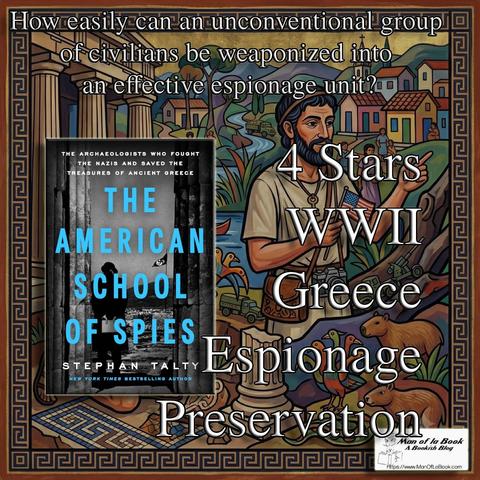
My rating for The American School of Spies - 4
Buy The American School of Spies from Amazon.com*
More books by Stephan Talty*
Thoughts:
The book makes the point that protecting historical artifacts is sometimes just as important as as protecting its borders. A group of academics, archaeologists and classicist are, mostly of Greek origins, went undercover to try and save antiquities, and Greece itself from the Nazis.
The American School of Spies by Stephan Talty tells of their mission in an exciting, readable manner. The Greek and American scholars have weaponized their knowledge of the Greek language, its history, mythology, antiquities, the greed of Nazi officers and, of course, geography to execute high-risk operations in both sabotage and hiding antiquities from plunder.
The book's most interesting part is the psychological transition of the amateur spies. They went from academics, teachers, and researchers to forging documents, lying, and coordinating resistance cells while the Gestapo is a step or two behind them.
Man of la Book’s Margin Notes: Weaponizing the Archives
1. Exploiting the "Historical Database"
The archaeologists recruited by Rodney Young for the OSS Greek Desk possessed a unique operational asset: they had spent years meticulously mapping the ancient topology of Greece. When the Nazi war machine occupied the country, they viewed it through a modern, standard military lens.
The scholar-spies, however, understood the terrain at a fundamental logic layer. They knew the hidden caves, unmapped subterranean passes, and ancient vaults beneath Athens itself. By treating these ancient ruins as an "air-gapped" physical storage system, they successfully cached priceless relics out of the reach of Nazi looters.
2. The Identity Spoofing Protocol
To operating effectively behind enemy lines, the scholars had to run a continuous, high-risk deception program. They leveraged their deep linguistic skills and cultural integration to blend into the local population background logs.
More brilliantly, they fought the Nazi obsession with antiquity by utilizing Honey Pots. Knowing the high-ranking fascists had a desperate lust for ancient treasures, the Greek Desk and their allies crafted meticulously detailed fakes to surrender to occupiers—effectively feeding corrupted data into the Nazi plunder pipeline while the real assets remained safely hidden in secure, offline locations.
3. Asymmetric Information Warfare
Traditional intelligence agencies often struggle in specialized cultural environments. By building a customized, localized team—combining American academics with gritty Greek refugees and local fighters—the OSS created an highly resilient, decentralized network. They could read the nuances of local sentiment and spot Axis vulnerabilities that a standard military unit would completely miss, proving that in deep tradecraft, specialized subject expertise is often the ultimate force multiplier.
This is an amazing story that, as far as I know, have fallen under the shadow of Europe's Monument Men. Saving the heritage of Greece, could be seen as saving the founding of democracy itself. Ironically, Greece, at the time, was not even a democracy. I enjoyed the combination of the quiet, efficient and all too human academics turned spies and saboteurs, to that of the likes of William J. "Wild Bill" Donovan, the aggressive head of the Office of Strategic Services (OSS).
This book, however, does take careful reading, and even that sometimes doesn't work. The intricate story or intricate networks got me lost at several points. The author always goes back to the main mission, but the side missions, which are important and exciting, still took me out of the narrative and it was a challenge to get back.
Buy The American School of Spies from Amazon.com*
More books by Stephan Talty*
In our modern age of automated, satellite-driven surveillance, do you think localized human expertise and historical knowledge are still critical intelligence assets, or has spycraft permanently shifted to a purely technological game?"
Zohar — Man of la Book
Disclaimer: I got this book for free
*Amazon links point to an affiliate account, the money is usually spent on books












In our modern age of automated, satellite-driven surveillance, do you think localized human expertise and historical knowledge are still critical intelligence assets, or has spycraft permanently shifted to a purely technological game?”