About:
The Next Journalism: How the Press Must Change to Serve Democracy by Tom Rosenstiel criticizes the modern press for using antiquated and irrelevant practices, offering clear alternatives. Mr. Rosenstiel is a journalist, scholar, and best-selling author.
- 400 pages
- Publisher : Crown
- Language : English
- ISBN-10 : 0593800192
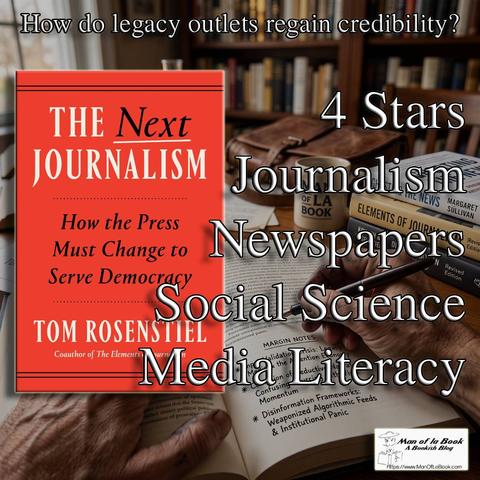
My rating for The Next Journalism - 4
Buy The Next Journalism from Amazon.com*
More books by Tom Rosenstiel*
Thoughts:
I'd be the first to admit that this book is not geared towards schmos like me. I decided to read it because I have an interest in misinformation and disinformation and noticed, the past three years or so, that legacy media has dropped their due diligence for factfinding and embraced immediacy "breaking news" coverage.
I subscribe to several digital newspapers, because I thought that I'd be able to get facts, not clickbait headlines. Quickly I realized that I am getting clickbait headlines under the guise of "reliable journalism", with a political agenda added on for good measure. Not only that, but tracing back sources for such prestigious publications I often ended with a tweet, reddit or TikTok posts used by "journalist" to push a view point or an agenda.
Shameful.
Mr. Rosenstiel cemented my suspicion that previously respectable news organizations are prioritizing clicks over truth, and that current journalism has little value. In fairness, journalism had little value since the "intellectualization" of the field, when journalists stopped being the guys that hung out at the docks or city hall, to use two cliché examples, to write stories which have relevance to people's everyday lives. Everybody wants to be "in the room where it happens", but most people don't care.
The Next Journalism argues that journalists need to shift focus from inflammatory content to that which helps regular people navigate the complex, often glacially paced, matters that are of concern to them, and I couldn't agree more. Sure, it's not as sexy as getting your picture taken in the White House, but it's of interest to people.
Man of la Book's Margin Notes: Sourcing, Misinformation, and the Decline of Fact-Checking
1. The "Input Validation" Crisis in Legacy Media
Programming 101 tells the developer to never trust user input. Always make sure to check an authoritative source, or at the very least sanitize the input before moving ahead. A structural flaw I find in many newspapers (usually the digital versions) is the fight over the attention economy, bypassing the verification phase.
Elevating viral posts from X, a hive of misinformation, or upvoted comments from Reddit, an echo-chamber like no other where bots have the power to raise or sink a comment, gives them gravitas and credibility. This is disservice to the readers who trust those institutions.
This is not only disingenuous, but dangerous as Charles Galvin's A Few Bad Men made it clear. When trusted institutions use social media crowd-source claims, many started by the West's geopolitical adversaries, as authoritative sources without verification the claims, they commit catastrophic fraud on their paying readers (like me), and reality itself.
2. Historical Precedent: The Contagion of "Lived Myths"
Taking Internet stupidity and rumors as a legitimate source might be new only because of technology. But using hearsay as an authorized source to ideas one already believes in, or wants to believe in, is nothing new.
Mike Rothschild's Jewish Space Lasers explores this aspect of disinformation. Ironically enough, the title is also taken from a disinformation campaign. The book explores the origins of anti-Semitic conspiracy theories and falsehoods, which were repeated so many times that even accredited historians cited them as "facts". This is just as bad as historians citing Shakespeare play as a source for historical books (which has happened as Stacy Schiff points out in her biography of Cleopatra).
Today's most trusted sources unwittingly (even though when it comes to pushing an agenda, we can assume it's wittingly) also cement Internet speculation, misinformation, disinformation, plain stupidity, and hoaxes as accurate instead of trending nonsense.
3. The Psychology of Seductive Narratives
Humans are built to treat sensational Bodacious Speculation as a compelling narrative, instead of a slow, methodical, unfolding one. Unproven, Unlikely, and Firmly Believed by Jonn Elledge and Tom Phillips demonstrate this phenom over and over again, it seems that nuance has not place when tearing someone, something, down to the ground.
Unfortunately, legacy outlets, which are of course made up of humans that are no better than you or I, also fall into this trap. Maybe a step above reddit's echo-chamber, they not only cater to the audience's confirmation bias, but shamelessly quoting unchecked posts by Internet strangers to shape the narrative they want to push simply to fit it into their view of the world they imagine, instead of the one they live in which counters their beliefs damage their brand and society for the foreseeable future.
4. Man of la Book's Guidelines to Identify Disinformation / Misinformation / Propaganda (online and in print)
This has been a topic of interest, and a hobby for the past decade, here are a few things I learned:
- If any article / meme makes you feel anything at all (mad, happy, scared, etc.) you're probably being manipulated.
- Articles that cite partisan sources as neutral authority (ex: rely on the testimony of ideologically aligned activists).
- Leading with outlandish headlines, while the actual context is buried or missing.
- Representing one side only, while the other is either missing or is represented by generic statements.
- Using one data point from a complex issue to prove their assertion (popular with health articles, but has moved to geopolitics).
- Reading / hearing the same exact narrative in multiple news outlets usually means it originated from the same source (and frankly, it's just lazy journalism).
The New York Times and BBC are guilty of all of the above (as well as partisan outlets, but they don't pretend to be unbiased)
What is the single most important reform mainstream media outlets need to make to regain your personal trust?
The book doesn't just criticize, it offers solutions in the form of roadmaps on how journalists can change the trajectory of their occupation from prioritizing meme-news to that of a serious, fact-based stories. I still remember the first time someone told me, in all seriousness, that TikTok is a great news source. I waved the whole thing off thinking it was a fluke, but I was wrong, and sadly it's getting worse as today news are consumes through humor and memes.
In my case, and it's anecdotal of course, I found that The New York Times often relied on unverified viral posts (heavily upvoted tweets or reddit comments, and actually admit it: "Reddit is a gem of the internet, and a trusted source of news and entertainment for millions of people") which, to me, undermined their whole brand and damaged trust and readership. Sadly, they haven't learned their lesson and keep promoting misleading narratives, spreading misinformation under the guise of a trusted source. I mean, they used reddit as a trusted source.
Overall, the book is both insightful and thoughtful, putting forth good ideas which, as I understand, are neither new nor novel, in an organized and disciplinary manner. I think I can speak for most of us when I say that we expect the media to question policy and be skeptical of what government is trying to sell us.
If only that would sell newspapers.
Buy The Next Journalism from Amazon.com*
More books by Tom Rosenstiel*
Zohar — Man of la Book
Disclaimer: I got this book for free
*Amazon links point to an affiliate account, the money is usually spent on books