About:
Push the Wall: My Life, Writing, Drawing, and the Art of Storytelling by Frank Miller is a biography/memoir/creative advice of the legendary creator. Mr. Miller is a comic book artist, writer, screen writer, and a movie directory with his own legion of fans.
- 224 page
- Publisher : S&S/Saga Press
- Language : English
- ISBN-10 : 1668065290
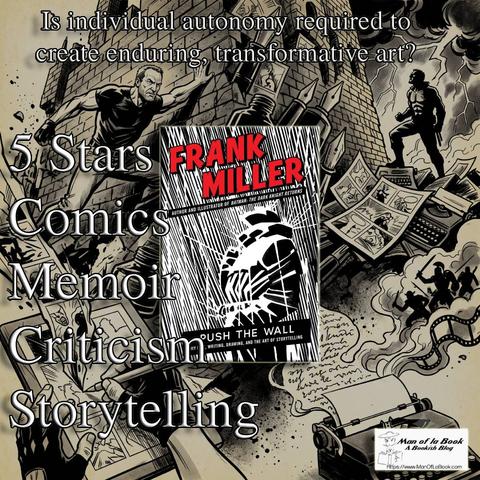
My rating for Push the Wall - 5
Buy Push the Wall from Amazon.com*
More books by Frank Miller*
Thoughts
Like many fans of the comic book medium, I have appreciated Mr. Miller's unique style of storytelling and artistry. When I saw that he published a memoir, I know I'd be in for a treat and jumped on the opportunity to read it.
Push the Wall by Frank Miller is told in 16 chapters, each one retraces his artistic evolution from a wide-eyed, optimistic teenager arriving in the 1970s grimy, dirty New York City to his role in reshaping comic book art and storytelling, as well as seeing his work displayed in the Louvre.
Throughout his journey, the author, along with other creators, has managed to change the minds of many in the art world about comic books. Thanks to his innovative storytelling and artwork in such classics as Daredevil, Sin City, 300, and Batman: The Dark Knight Returns, they managed to take the art form for disposable properties to high-art.
Man of la Book's Margin Notes: The Comic Book as a Renegade Art Form
As a fan of the comic book art form, I've read several biographies of luminaries in the field. One of the things that jumped out of the pages at me is the vastly different philosophies on what a comic book is-ranging from a commercial corporate engine to a deeply personal canvas for survival.
- Push the Wall vs. Liel Leibovitz's Stan Lee
Stan Lee is one of the biggest names in the creation of comics, and certainly the biggest in making them huge pop-culture phenomenon. The contrasts between Stan Lee's philosophy, as written in his biography by Liel Leibovitz, and Frank Miller's are strikingly different.
Stan Lee believed in a corporate, myth-maling system, his biography represents him as both a creator and a businessman who has no qualms about selling out some of his creations. He viewed the industry as a collaborative effort to create a seamlessly integrated American mythology, just as much as he viewed the industry as a huge pop-art engine. Stan Lee measured success by the ability to reach as many people as possible, no matter the medium, and welcomed the massive corporate ecosystem.
Frank Miller, on the other hand, does not embrace the assembly-line model of the creative process. He thinks that the crudeness of comic books, part of the art form, might be what protects the artists from corporate management. Stan Lee wanted a big ecosystern to include everyone, while Mr. Miller believes that the individual expressing raw ideas, even if they're politically incorrect or-let's face it-misinformation, refusing to compromise is the power of the medium.
2. Push the Wall vs. Neil Gaiman's The View from the Cheap Seats
Neil Gaiman's book, a non-fiction collection, looks at the art of comics through a literary lens. He focuses on magical realism, fluid artistry, and elegance. The boundaries between writing for the screen, books and comics might not be the same, but they have a lot in common.
While Neil Gaiman invites the reader into his dreamlike, fantastical worldbuilding, Frank Miller's wants-no, demands of the reader to expand the space in which a comic book page could previously tolerate. Literally and figuratively "push the wall". He views the medium through a lens where the ink flows, the panels are aggressive, pulling the reader into a 1970s cinematic aesthetic of a grainy world designed to reflect moral crisis.
3. Push the Wall vs. J. Michael Straczynski's Becoming Superman
J. Michael Straczynski powerful autobiography Becoming Superman, details his use of comic books, sci-fi, and writing to survive his very difficult, abusive, childhood. For him, the superhero, specifically Superman, was the basis to a moral baseline and ethical code which will guide a person on how to become a better human being, especially in a toxic environment.
Mr. Straczynski looks at comic book superheroes as a shield to protect humanity from itself. Mr. Miller, however, look at these icons and thinks "how can I tear them down" to reveal their scared souls, and the psychological damage which is often caused by obsessively trying to hide the rage within them. Frank Miller's Batman and Daredevil aren't flawless heroes, moral paragons looking out humanity, but deeply flawed men molded by sad and tough environments whose fight is more to assert themselves against an unjust and corrupt system.
I really enjoyed reading about his creative process, which was sometimes derailed by industry censorship. The sections which talk about pacing were fascinating to me, a subject that I never thought about but, I guess, subconsciously followed.
Mr. Miller shines a bright light on practical storytelling which I found very interesting. He explains, as a creator, why he must know the ending before starting to draw a single panel. He goes into a high-level, but nevertheless fascinating, about the environment being an obstacle to the protagonist, using them as a pinball between harsh and dark lights.
Thinking back to his work, it's a mark of Frank Miller's distinct and aggressive noir style.
Buy Push the Wall from Amazon.com*
More books by Frank Miller*
Mr. Miller argues that the true strength of comics lies in their historical status as a cheap, renegade art form that bypassed corporate focus groups. Now that comic book characters serve as the foundational code for the global entertainment infrastructure, has the medium lost its iconoclastic edge, or can independent creators still find a way to hack the system from within
Zohar — Man of la Book
Disclaimer: I got this book for free
*Amazon links point to an affiliate account, the money is usually spent on books














Mr. Miller argues that the true strength of comics lies in their historical status as a cheap, renegade art form that bypassed corporate focus groups. Now that comic book characters serve as the foundational code for the global entertainment infrastructure, has the medium lost its iconoclastic edge, or can independent creators still find a way to hack the system from within