About:
Next Level: Making Games That Make Themselves by Mike Cook explains the world of Automated Game Design (AGD). Dr. Cook is an English game designer and academic.
- 288 pages
- Publisher : Bloomsbury Sigma
- Language : English
- ISBN-10 : 1399423398
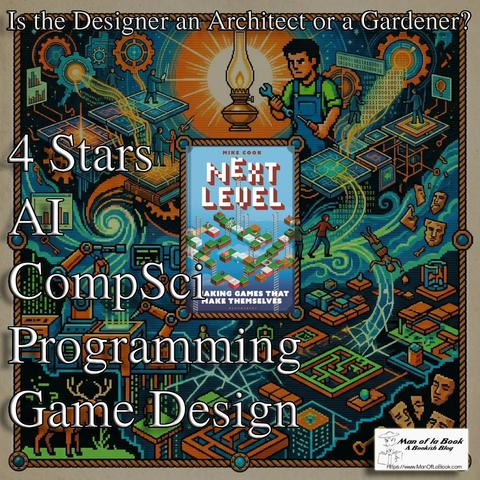
My rating for Next Level - 4
Buy Next Level from Amazon.com*
More books by Mike Cook*
Thoughts:
In this book, the author finds a nice balance between creative entertainment and rigorous algorithmic logic. Like many other occupations, Al is changing the gaming industry, and this is true for the gaming industry as well.
Mike Cook's Next Level makes the argument that the future of gamine lies in Generative Design. This technology can create systems that autonomously build games, including creating levels and interactions based on user experience.
The title is misleading, no one is going to learn how to make "games that make themselves" by reading this book. You'll get a nice, somewhat granular overview of the technology. You don't have to read the whole book to realize it though, the first chapters will tell you exactly that this not what it's about.
Man of La Book's Margin Note: The Price of Abstraction
In my world, "optimization" wasn't just a best practice—it's a survival tactic.
1. The Era of the "Manual World"
Decades ago, the "environment" didn't exist until we defined it in the source code. There was no "Enable Gravity" checkbox in a sidebar. If you wanted a sprite to fall, you manually calculated acceleration vectors. If you wanted a shadow, you were doing the trigonometry to project a shape onto a plane. Every single line of code had to "earn" its place in memory. We spent the majority of our development cycle squeezing every bit of juice out of the CPU, optimizing cycles just to keep the frame rate stable. In that era, the "soul" of a game was forged in the friction between the creator's vision and the hardware's strict limitations.
2. The Rise of "Engine Homogeneity"
Today, we have entered the age of the Middleware Giant. Engines like Unreal and Unity handle the "heavy lifting" (physics, lighting, shaders) straight out of the box. While this has democratized game development, it has also led to "systemic sameness". Because so many developers are using the same global illumination algorithms and the same physics libraries, games have started to look like they all came from the same high-resolution factory. They have high fidelity, but they often lack a unique technical identity.
3. Graphics as a "Hardware Mask"
Dr. Cook’s book explores AI-driven design, but it also inadvertently highlights a modern industry flaw: Graphics are now used to mask a lack of gameplay innovation. It is much cheaper for a large studio to buy a "High-Res Asset Pack" and let a powerful engine render it beautifully than it is to architect a unique, never-before-seen gameplay mechanic. We have traded Mechanical Depth for Visual Resolution.
4. The QA Challenge
From a Software Assurance perspective, this move toward "engines that build themselves" creates a massive Traceability Gap. If a game uses a pre-built engine and an AI-generated level, who is responsible when a "Zero-Day" gameplay bug appears? We are moving from being "Artists who code" to "Auditors of the Engine."
I enjoyed the deep dive into the autonomous architecture which is discussed. I've built some games previously, some for fun, some for work (but they were still fun) but my experience was different as we had no engines. I still play games, if my limited time permits me, but I enjoy mostly RPG's like Assassin's Creed and Red Dead Redemption.
The author goes into some philosophy discussion about the nature of creativity. It was an interesting, thoughtful and fair discussion. I'm not an artist and really don't know enough or heard enough discussion to form an opinion. All I know is that Al can make graphics for this blog that I couldn't dream of making even if I worked whole days on them.
This is not an easy read though. If you're not interested in the mechanics of Al, technical granularity, or game theory and a bit of math, you'd probably find this book boring.
Buy Next Level from Amazon.com*
More books by Mike Cook*
"We used to make games 'smart' because the hardware was 'dumb.' Now that the hardware is 'smart' and the engines are powerful, have we let our creativity become 'lazy'? Is the 'Engine Era' why we have 4K graphics but 1-bit gameplay loops?"
Zohar — Man of la Book
Disclaimer: I got this book for free
*Amazon links point to an affiliate account, the money is usually spent on books