Literature and Halloween have a long, enchanted history. Famous and celebrate authors have, for centuries, reshaped the season long before horror flicks took over the silver screen.
1. The term Halloween was popularized by Scottish poet Robert Burns in his 1785 poem aptly titled Halloween. The poem is about tradition fortune-telling customs in Scotland and folklore about the ancient Gallic festival Samhain (sow-in), which marks the end of the harvest season.
2. I bet if you ask someone where Dracula takes place, you’ll immediately get “Transylvania” as the answer. In fact, in Bram Stoker’s excellent novel, Dracula indeed starts in Transylvania, but the majority of the story takes place in Whitby, an English seaside town, and London.
Mr. Stoker, however, wasn’t the first to write about vampires. The Vampyre, a short story by John William Polidori in 1819 introduce the aristocratic vampire trope.
3. Stingy Jack, an Irish myth, is about a trickster who managed to trick the Devil, as punishment he was doomed to roam the Earth with a hollowed turnip containing burning ember. When Irish immigrants came to America, the swapped the turnips for the native pumpkins and the Jack-O’-Lantern was born.
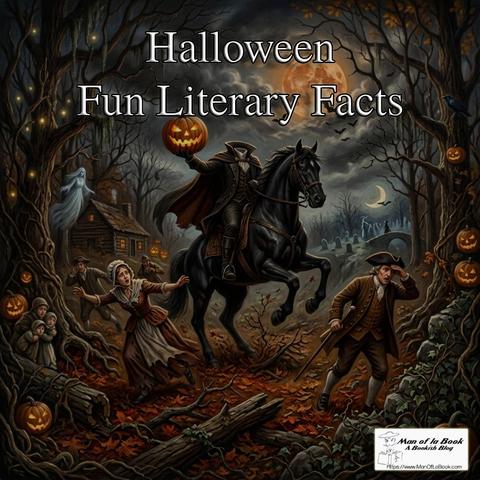
4. The popular story The Legend of Sleepy Hollow, written in 1820 by Washington Irving, popularized the Headless Horseman. Mr. Irving, however, drew heavily from Dullahan, a traditional Irish folklore tale. Dullahan is a bout a headless fair, riding a black horse, carrying its own head under his arm.
Irving’s Headless Horseman is the ghost of a Hessian artilleryman whose head was shot off by a cannonball during the Revolutionary War (he didn’t mention which battle).
5. The characters in Shakespeare’s Macbeth speak in iambic pentameter (a line with 10 syllables), while the witches speak in trochaic meter (a stressed syllable is followed by an unstressed syllable). This gives the witches’ speech an unnatural sound which sounded sinister to the audience of the time.
6. American master of gothic terror, Edgar Allen Poe, never directly wrote about Halloween, or set a story on that day.
7. The author of A Christmas Carol, Charles Dickens, loved the supernatural He often published eerie tales in Household Words and All the Year Round his weekly periodical during the autumn season.
8. In 1927, the Blackie Review, a newspaper in Alberta, Canada was the first to use the phrase Trick or Treat.
9. The Graveyard Book by Neil Gaiman reimagined Rudyard Kipling’s The Jungle Book as a dark, gothic tale. The boy is raised by ghosts in a cemetery instead of wild jungle animals.
10. Telling scary poems by candlelight (or campfire) on 31 October was a popular Victorian parlor game in England and New England. Some of the more popular works were by Lord Byron, Edgar Allan Poe, and Christina Rossetti.
Zohar – Man of la Book