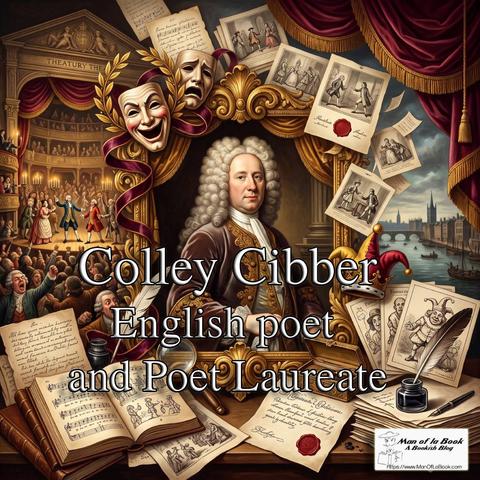
Colley Cibber (6 November, 1671 – 11 December, 1757) was an English poet and Poet Laureate, who is remembered as a pioneer of sentimental comedy.
Books by or about Colley Cibber*
Fun Facts about Colley Cibber:
1. Colley Cibber was born in Bloomsbury district in the West End London. His father, Caius Gabriel Cibber, was a famous sculpture and immigrated from Denmark. His mother Jane Colley, came from a village in the East Midlands of England, named Glaston.
2. He was educated at the King’s School in Grantha until he was 16 years old. He did not gain entry to study at Winchester College, despite the fact that he was related to Bishop William of Wykeham, the school’s founder.
3. After the Glorious Revolution, the overthrow over King James II of England, Mr. Cibber found his calling on the stage as an actor at the Drury Lane Theatre acting for Thoms Betterton’s United Company. At first, he was mocked for his tragic roles, but his fashion obsessed, vain, and overly refined characters of made him a comic legend.
4. William Shakespeare’s classic play, Richard III, was adapted by Colley Cibber to be a more action focused drama. David Garrick, the famous and beloved actor, made his London debut in Mr. Cibber’s adaptation. The line “Off with his head! So much for Buckingham!” is actually Cibber’s and is often misattributed to Shakespeare.
The 1699 play was so successful it run until 1750, or there abouts.
5. Colley Cibber and Alexander Pope did not like each other, to say it mildly. They feuded often and Mr. Pope even revised his satire, The Dunciad, to call Mr. Cibber the head “Dunce”, a symbol of stupidity and bad literary taste.
Not one to stay silent, Mr. Cibber published an open letter to Pope in 1742, recounting the time he took the young Pope to a brothel, causing a major public scandal and not endearing himself to Mr. Pope.
6. He was named Poet Laureate of the United Kingdom in 1730 not due to his literary talents, but due to his very enthusiastic and vocal support of Prime Minister Robert Walpole and the Whig Party. He was, once again, universally mocked being called the King’s “Fool and Poet”.
7. His biography, An Apology for the Life of Colley Cibber (1740) is one of the earliest full length theatrical autobiographies published in English. It is still one of the primary sources of those who are interested in ways the 18th Century London stag was ran.
The “apology” in the title is the classic definition of the word, meaning a defense or justification, not an expression of regret. His cheerful self-satisfaction is what drove Alexander Pope to call promote him in The Duncia.
8.As the co-manager of the Theatre Royal, Drury Lane, a job Colley Cibber held for a long time, he helped to create the modern actor-manager. He wasn’t perfect and rejected John Gay’s The Beggar’s Opera to be performed in his theater. The play, of course, went on to become an unprecedented hit at a rival theater.
9. Henry Fielding, like Pope, made Colley Cibber a ridicule target. In fairness, Mr. Cibber’s huge ego and style made it easy for them to mock. Unlike Pope, however, Henry Fielding mocked him on the stage in scathing parodies. This backfired when the Theatrical Licensing Act of 1737 introduced censorship to the British theater.
10. Despite being mocked often, or maybe because of it, Colley Cibber developed a thick skin and outlived almost all of his fiercest satirists. Ironically, Mr. Cibber is not remembered today because of his poems are plays, but because Alexander Pope wrote such brilliant verses immortalizing him as England’s literary anti-hero.
Zohar — Man of la Book
*Amazon links point to an affiliate account
Sources:
Colley Cibber | Wikipedia
Colley Cibber: English Actor, Poet, Playwright & Author | Britannica
Colley Cibber facts for kids | Kids Encyclopedia Facts