Augustine of Hippo (13 November, 354 – 28 August, 430) was a Christian theologian, philosopher and Bishop of Hippo Regius. He is better known today as Saint Augustine, the patron saint of printers, theologians, and sore eyes.
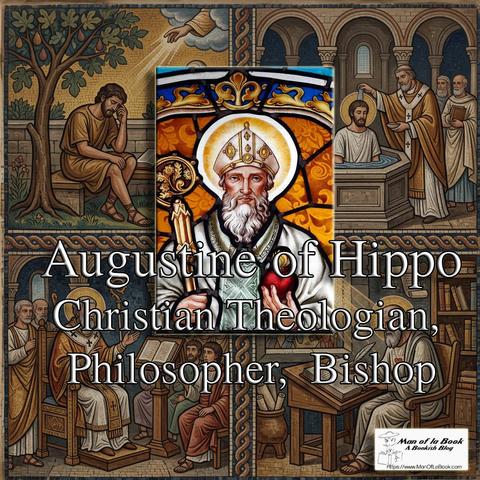
Books by St. Augustine of Hippo*
Fun Facts about Augustine of Hippo:
1. Aurelius Augustinus Hipponensis was born in a Roman-Berber city called Thagaste in North Africa (now located in Algeria). His mother Monica/Monnica was a very devout Christian and his father, Patricius, as a pagan, but converted to Christianity on his deathbed.
2. We obviously don’t know much about his childhood, but researchers believe that the family were Berbers (indigenous to North Africa), but identified, and took pride in being Romans. We know from his writings that he refers others as being “ours, insofar as being African”.
3. The family’s last name, Aurelius, suggests that his father’s family were freedmen who were given full Roman citizenship at least 100 years before he was born.
4. Young Augustine was known as a star student, eager and curious. He learned Latin and was sent to school far from home. However, he never learned Greek, this is because his first teacher was a violent man and the would be Christian priest rebelled.
5. Augustine taught public speaking and rhetoric in Carthage, Rome (now in Tunisia). He was so good that he was named as the official imperial orator for the court in Milan. During this time he lived for 15 years with a woman whose name has been lost to history. He loved her very much and was heartbroken when they had to separate do to their social classes. They had a son, Adeodatus (Latin for “Given by God”), who was very smart as well, but passed away at age 17.
6. He followed Manichaeism for nine years, drawn to its explanation of good vs. evil and critique of Old Testament scripture. This was before converting to Christianity. Manichaeism was major world religion founded in Mesopotamia around the 3rd Century. The religion defined the universe as a conflict between two opposing forces (dualism), light (good) and darkness (evil matter).
7. Augustine’s Confessions is a very personal narrative of his own self-examination. The book, written in the late 390s, is considered to be the first major Western autobiography.
6. In Book II of Confessions, the author spent many pages on his teenage heist of stealing pears from his neighbor’s tree. He wasn’t hungry and never ate the pears (feeding them to the pigs), but he got a thrill from doing something forbidden.
8. In 410 AD, the Romans blamed Christians for abandoning the pagan gods after the Visigoth sacked Rome, the major geopolitical crisis at the time. Augustine wrote The City of God (De Civitate Dei) as a rebuke of that assertions and argued that there’s a clear distinction between earthly kingdoms and the divine. The work took him 13 years to complete and was published in 426 AD.
9. As a theologian, he formulated the concept and doctrine of Original Sin. He argued that the fall of Adam is responsible for the inheritance of guilt.
10. His song, Psalm against the Donatist Faction (Psalmus contra Partem Donati), was written in rhyme to reach common people who were unable to read the theological texts.
Books by St. Augustine of Hippo*
Zohar – Man of la Book
Resources:
Augustine of Hippo | Wikipedia
Saint Augustine of Hippo | What You Need to Know | Augustinian Province of Saint Thomas of Villanova |