About:
The Mask of Dimitrios by Eric Ambler follows a detective novelist on a mission to reconstruct the life of a notorious criminal who passed away. Mr. Ambler is a British writer, specializing in espionage novels, and journalist.
- 240 pages
- Publisher : Penguin Books
- Language : English
- ISBN-10 : 0141190337
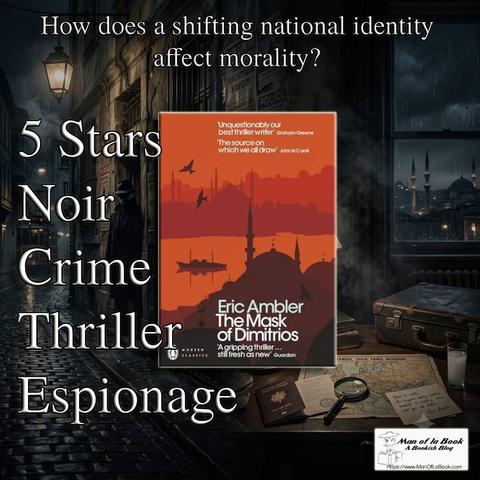
My rating for The Mask of Dimitrios - 5
Buy The Mask of Dimitrios from Amazon.com*
More books by Eric Ambler*
Thoughts:
I discovered this book through the Ian Fleming's Foundation James Bond Book Club (June 2026). According to their announcement, this book "inspire Ian Fleming's creation of James Bond", as well as provided inspiration for many other writers. In fact, James Bond reads this book in From Russia with Love on the Orient Express to pass the time.
The Mask of Dimitrios by Eric Ambler (published in the US as A Coffin for Dimitrios) was published in 1939 but the story takes place sometime between the two World Wars. Mr. Ambler builds Markopoulos bit by bit. His evil persona is slowly reconstructed for Latimer's book search via people who knew, betrayed and ruined.
This is not a flag waving, British Empire/God Save the Queen/stiff upper lip type of book. The characters aren't black and white but come in grim shades of gray. Morally bankrupt characters are mixed with those who, after World War I, might have some ethics left in them, but not much.
The book sees the transition from a villain who worked on his own behalf, to the corruption of institutions once held in high regard. Espionage is not a song and dance occupation any longer, but a grim transactional business infiltrated by multinational corporations. The book shows a fractured, post-war Europe that ignores borders.
I can certainly see how this book, and others inspired Fleming. The secret agent is now a professional weapon of the state, the good guys and bad guys are separated by who signs their paychecks, and the new, shadowy world order is more vulnerable than before.
Man of la Book's Margin Notes: lan Fleming's World vs. Modern Reality
In 1953, when James Bond and Vesper Lynd were drinking martinis at lunch, geopolitics looked much different and everybody knew the rules. The West represented democracy and freedom, the East was a cold, monolithic communist machinery. The world was transitioning from empires to states, and a gentleman spy might have still been able to tip the balance of powers towards their masters.
Theoretically!
That, of course, was a fragile illusion.
1. The Breakdown: Systemic Paranoia vs. Solo Heroics
The Able Archers by Brian J. Morra is a historical thriller of a world in crisis, on the edge of being destroyed by a nuclear war. This kind of danger evolves from Fleming's world by a singular, usually odd and theatrical, villain.
The novel illustrates, very realistically I thought, the real threat isn't from the proverbial Ernest Stavro Blofeld sitting in a dormant volcano planning to destroy the world, but from systematic paranoia, misread or understood data, and rigidity without the ability to adjust. Mr. Morra reminds the readers that survival usually rests on smart people, sitting in "government gray" rooms, refusing to push a button.
2. The Shift: Multi-polar Realpolitik vs. Eurocentric Empires
lan Fleming, for his skills as an intelligence officer turned writer, was nonetheless very Eurocentric, focusing on the crumbling British Empire. On China by Henry Kissinger looks at statecraft from a different perspective, that of thousands of years of traditions, not decades.
While 007 sees the world as a high-stake baccarat game, to be decided in one evening, Mr. Kissinger describes Shi, a Chinese concept of strategic positioning. The game of Go is an example of such strategy, where the goal is long-term encirclement and patience, rather than a dramatic finish to kill the Shah. While Felming's Cold War is absolute, Kissinger takes on the fluid, long-term, and pragmatic view of realpolitik.
3. The Finale: Crashing into the 21st Century
Andrew Bacevich's After the Apocalypse: America's Role in a World Transformed is probably the biggest shift from Fleming's world. The assumption that intelligence supremacy and military dominance will bring global stability is no longer something the world can assume to be correct.
Mr. Bacevich does not hold his punches; he delivers a blunt are rebuke of Western exceptionalism, Arguing that the tools used in the late 20th century, such as military intervention, global power projection, and aggressive posturing, are no longer suited for the 21" century.
Today's battlefields are no longer in the shadowy basements where global supremacy is fought and decided through tools of the state. Instead, climate, inequity, and weaponization of information are the true dangers, and are existential in nature.
According to Bacevich, today's true battlefields aren't secret underground bases; they are climate change, systemic inequality, and the weaponization of digital information. The rogue agent with a license to kill is useless against a destabilized biosphere or a global pandemic.
GEOPOLITICAL EVOLUTION
Looking at these books in the following order, it's clear to see the trajectory the world has taken. From lan Fleming's world of a romanticized individual combatants, to massive, interlocking systems and non-military threats to the whole world, not a single nation.
Fleming's Era (1950s) -> Bipolar certainty & imperial control
Morra's Able Archer -> Systems, computer loops & catastrophic error
Kissinger's On China -> Realpolitik & historical fluid borders
Bacevich's After the Apocalypse -> Decentralized crises & end of exceptionalism
Synopsis:
University professor and successful mystery writer, Charles Latimer, meets a Turkish secret police officer while vacation in Turkey (because, who doesn't?). Colonel Haki shows Latimer the fresh corpse of the notorious international criminal Dimitrios Makropoulos.
Amid an idea for a new book, Latimer attempts to reconstruct Makropoulos life. The project becomes an obsession taking him across Turkey, Greece, the Balkans and Europe.
Buy The Mask of Dimitrios from Amazon.com*
More books by Eric Ambler*
In The Mask of Dimitrios, Charles Latimer realizes that real-world espionage is completely different from the neat, tidy mysteries he writes at his desk. Which book or author first shattered your own "romanticized" view of a genre and showed you how gritty, messy, and complex the real world actually is?
Let’s talk in the comments below!
Zohar — Man of la Book
Disclaimer: I bought this book
*Amazon links point to an affiliate account, the money is usually spent on books












Which book or author first shattered your own “romanticized” view of a genre and showed you how gritty, messy, and complex the real world actually is?
Great question. Dune and Game of Thrones both show that power brings danger and that brutal political tragedy is often traded for noble heroism.
If you read the old fairytales, you’d be shocked at how violent they are