About:
The French Illusion by John Grisham is tells of an American hunt for a group of kidnappers with unknown motives. Mr. Grisham is an award-winning, best-selling author specializing in legal thrillers.
- 352 pages
- Publisher : Doubleday
- Language : English
- ISBN-10 : 0385550545
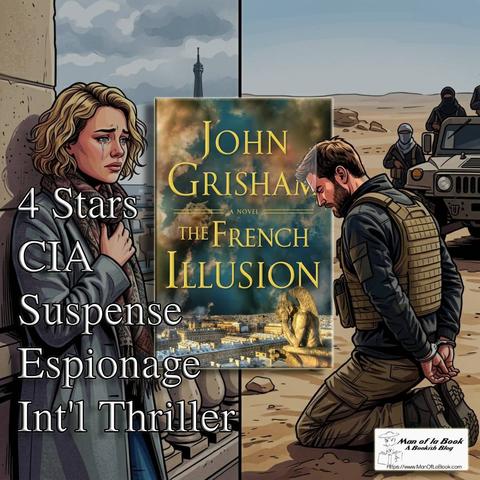
My rating for The French Illusion - 4
Buy The French Illusion from Amazon.com*
More books by John Grisham*
Thoughts:
This novel was a departure for Grisham's books, the courtroom legal thriller was gone, and in came political intrigue in a high-stakes game. There's no mystery in this book, we know exactly who has done what, but there is cloak and dagger suspense.
The French Illusion by John Grisham starts in a strong way with the kidnapping of the newlyweds and the tense horror facing the families back at home. We, the readers, don't know why the kidnappings took place until much later, so we are simply witnessing the race to get money, and the immense decisions they have to make in very short order.
When the counterterrorism agencies get involved, the book becomes morally grey. They are stuck between a rock and a hard place, US policies vs. what must be done. These serious dilemmas make it all the way to the top decision makers in the country for resolution.
Man of la Book's Margin Notes: State Hypocrisy and the Policy of "No Negotiations"
I noticed that governments' lip taxes and actual acts differ, sometimes wildly. Strict doctrine is always flexible when it comes to national or international threats. One of those doctrines is the famous "we do not negotiate with terrorists. However, in practice, geopolitical survival trumps almost every safeguard or guardrail a country puts up for itself, and force nations to break their own "strict" rules.
Among the books I've read, whether fiction or non-fiction, a recurring theme is that official polices regarding terrorism are, many times, just a slight of hand designed for tough talk and publicity. The actual machinery which does the hard, grinding work operates in a gray zone governed by realpolitik rather than laws, procedures, and policies.
1. Hypocrisy as center stage
In The French Illusion by John Grisham, while official counterterrorism experts insist on the principals they hold dear, the clandestine services bypass these legal protections. They deploy a civilian as bait, while navigating extraordinary circumstances exposing the ugly reality all governments face. When national security demands it, our own declared principles will be violated by the same people who were sworn to defend them.
2. Official Denial vs. State-Sanctioned Trading
Illich Ramirez Sanches, or using his more famous nickname, Carlos the Jackal is an example of how governments actions and pronouncements differ wildly. In Joby Warrick's biography, The Jackal, the author examines how Middle East governments which publicly condemned the famous terrorist, covertly offered him sweet deals. These include granting him safe living, paying off his network, and, of course, a promise not to act on their own territories.
3. Extralegal Retaliation
John Wells is one of my favorite characters in espionage fiction. The Silent Man by Alex Berenson explores policies how championed by counterterrorism agencies are in direct opposition of how they actually do business. After 9/11 values such as human rights and democracy took a back seat to illegal detention, black sites and extrajudicial actions to ward off the threats of extremists.
4. Morality Under Siege
In his book The Restless Wave, Admiral James. G. Stavridis explores the moral ambiguity faced by Navy officers in wartime. The novel explores the rules of engagement, often sacred and rigid rules, are compromised on a regular basis to counter asymmetrical warfare and tactics used by adversaries.
5. The Illusion of Strict Non-Negotiation
Mimi Nichter was taken hostage by Palestinian terrorists in 1976 flying from Israel to the United States with two other planes. Her memoir, Hostage, tells of her experience in a real-world crisis, being used a a pawn by both governments and terrorists. While governments publicly maintained a zero-tolerance stance on paying ransoms, they utilized undercover channels, and concessions behind closed doors to get the hostages home safely.
As the novel progresses, the slow burn takes backstage to an uneven pacing, but that's fine since the narrative is still interesting. However, in a novel attempting to be grounded in reality, Mr. Grisham asks the reader to suspend logic when convenient, that is something I found disturbing and even lazy in some places. The ending, I thought, was also abrupt and not very satisfying, a disappointment because I really did enjoy the majority of the book.
Overall, I thought this was a very readable, and enjoyable thriller. Even though it felt rushed towards the end, the drama and theme of long-lasting consequences of geopolitics and personal revenge against a country's actions are still relevant
Synopsis:
Paul and Chelsea Tanner were looking forward to their dream honeymoon in Paris. Their trip, however, gets interrupted when the couple were kidnapped in the French countryside. The families pay the ransom, but Paul has not been released.
French Intelligence discovers that the newlyweds were not the first to be kidnapped in such a manner, other American couples have also been taken. To smoke out the kidnappers, the CIA plans an undercover operation, sending a young couple, with the same background to hopefully be taken and lead them to the missing husbands.
Buy The French Illusion from Amazon.com*
More books by John Grisham*
Zohar — Man of la Book
Disclaimer: I got this book for free
*Amazon links point to an affiliate account, the money is usually spent on books