About:
American Intellectual Antisemitism: The Anti-Jewish Movement Tearing Through Our Universities by Shai Davidai is a personal account of his experience as a staff member in Columbia University after October 7, 2023 when Hamas attacked Israel. Mr. Davidai is a former Columbia Business School professor and “accidental activist”.
- 352 pages
- Publisher : Wicked Son
- Language : English
- ISBN-13 : 979-8895655849
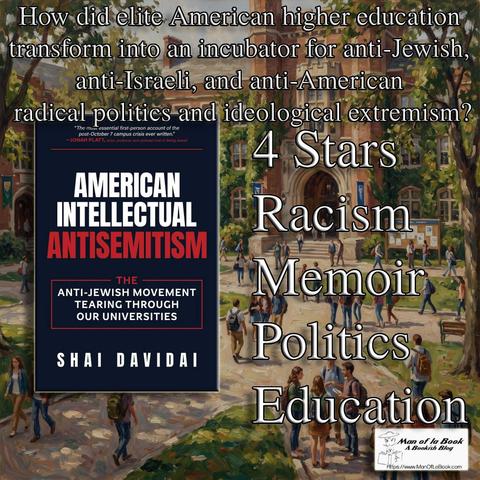
My rating for American Intellectual Antisemitism - 4
Buy American Intellectual Antisemitism for Amazon.com*
More books by Shai Davidai*
Thoughts:
I really can’t say I enjoyed reading this book, it’s a tough read and, honestly, a bit depressing. But it’s meant to be a tough read, as well as an analytical account, along with scathing criticism of the antisemitism so prevalent in elite American universities.
American Intellectual Antisemitism by Shai Davidai talks about the aftermath of October 7, 2023 when, like many others, he was surprised by the outpouring of hate and antisemitism which clearly were not spontaneous. Mr. Davidai, a left leaning Israeli who is known to criticize its government (an Israeli pastime, I understand) went viral with a speech he delivered at Columbia, and since then has been invited to testify before Congress, got fired, and navigated hostilities from the institution itself.
The theme of this book is that academic antisemites is “performative”, and many of its participants are pressured into the movement by professors (under the threat of failing, and I know many Jewish people who had to lie on assignments in order to get a passing grade), or the students themselves (under the threat of social isolation). These movements reduce a complex, intricate conflict into a binary “oppressor vs. oppressed” lens, viewing it through an American history lens (which makes no sense) and a fascist agenda of silencing those who disagree with them.
Man of la Book’s Margin Notes: The DEI Paradox
I. The Core Contradiction
In American Intellectual Antisemitism, Shai Davidai writes that he was, and still is, a believer in DEI (Diversity, Equity, and Inclusion) framework, and frankly so do I. I think diversity, especially in thought and life experience, creates better environments and products (as Google found out). He discovered, sadly, that in elite institutions the DEI frameworks are paradoxical. Educational institutions are proud to advertise that they foster inclusive environments, but there was a caveat, as long as you’re not a Jewish student or faculty. When Columbia University was confronted with antisemitism on campus, DEI offices and administrators ignored the students and hoped they’d go away, instead of extending those protections to the group that needed them most at the time. Instead, as easily predicted, the students and professors took their inaction as an implicit endorsement and multiplied their efforts.
Mac David Baer’s Children of Abraham explores the constructs which Mr. Davidai touches on. He goes to show how modern constructs of various ideologies purposefully break apart complex historical nuances and replaces them with polarizing narratives which are too rigid be analyzed properly.
II. The Power Dynamic & Selective Inclusion
Columbia’s administration was supposed to act as a natural firewall against bias but instead helped weaponize hate and violence but ideological conformity. Mr. Davidai’s encounters with Columbia’s DEI officials made him understand they they’re viewing him as an “oppressor” and are building a case against him, instead of building one against hostile actors on campus. The “inclusion” in this case was that of radical elements to preserve the institution and exclude vulnerable groups by political posturing.
Mike Rothchild documented in his book, Jewish Space Lasers, the subject of bad-faith political narratives (he does not mention DEI) which takes ancient prejudices and attempts to adapt them to modern tastes. Using algorithms, the bad faith actors create blind sports which allow people to rationalize ideas and viewpoints which they never would otherwise.
Shai Davidai highlights a glaring paradox in modern academia: systems built specifically to foster inclusion often failed to protect Jewish faculty and students due to institutional 'optics' and rigid ideological frameworks. Do you think higher education institutions can reform these administrative structures from within, or has administrative self-preservation permanently compromised their original mission?
The book raises a warning flag about contemporary academic culture, and the lost discourse in academia. He writes about a form of education which tells students what to think, instead of presenting them with information and asking them to view it critically and form an informed opinion.
While most of the students get a pass from the author, the administration does not. He brutally details how college administrations stood by and let radicals set the tone, agenda, and even university policies while implicitly endorsing the hate and violence by doing nothing, as well as explicit endorsement by professors who participated in the hate marches.
I could tell that writing this book was an emotional journey for the author. He does, however, takes a step back and analyzes the events in a structured, often cold look at careerism, administrative cowardice, and the overall state of higher education.
Buy American Intellectual Antisemitism for Amazon.com*
More books by Shai Davidai*
Zohar — Man of la Book
Disclaimer: I got this book for free.
*Amazon links point to an affiliate account