About:
90 Minutes at Entebbe: The Full Inside Story of the Spectacular Israeli Counterterrorism Strike and the Daring Rescue of 103 hostages by William Stevenson and Uri Dan is about the daring 1976 rescue which became the stuff of legend. The book was previously published under the title "Operation Thunderbolt. Mr. Stevenson is a Canadian author and journalist, and Mr. Dan is an American author and journalist.
- 240 pages
- Publication date : January 6, 2015
- Language : English
- ISBN-10 : 1510734384
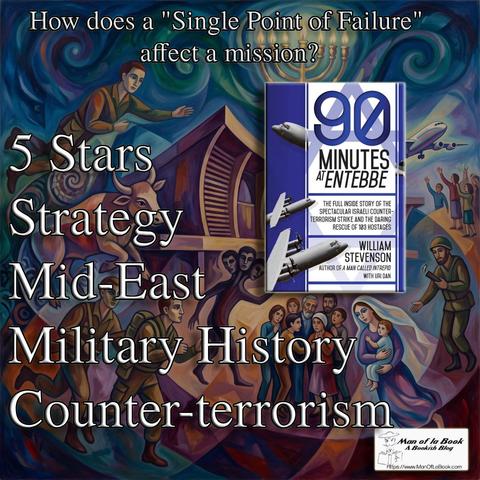
My rating for 90 Minutes at Entebbe - 5
Buy 90 Minutes at Entebbe from Amazon.com*
More books by William Stevenson*
More books by Uri Dan*
Thoughts:
Contrary to the title, the book talks about the preparations for Operation Thunderbolt, which took far longer than 90 minutes, even though they were done in days, not months. The rescue story has been told over and over again, but the charm of 90 Minutes at Entebbe is the deep dive into operational security (OPSEC), rapid deployment, and how intelligence led the way until the very moment the Israeli Special Forces landed in Uganda.
The tactical precision required to undertake a sensitive and dangerous military operation 2,500 miles away is still a marvel. The blacked-out environment contributed to the surgical strike at the heart of Africa, it was adhered to and everyone understood the high-stakes the mission encompasses, both politically and with the 102 human lives being held hostage.
Purposefully or not, the book is a study of information asymmetry. The mission's success didn't just depend on the soldiers executing it, but also the intelligence community's ability to get as much detailed information as possible, including the blueprints to the Entebbe terminal. This was a massive intelligence coup that allowed Sayeret Matkal to rehearse in a full-sized mock-up.
Man of La Book's Margin Note: The Intelligence "Exploit"
I found the most compelling question in the book to be: How do you build a simulation of a target you cannot see?
The Israelis had a massive "Legacy Data" advantage because an Israeli firm had built the Entebbe terminal. This allowed them to build a full-scale physical "sandbox" (a mock-up of the airport) to "stress test" their plan before deploying it to "production".
In modern terms, this was the ultimate Red Team Exercise. They identified the "vulnerabilities" in the Ugandan defense—such as the guards' reliance on visual cues (the black Mercedes)—and used those exploits to achieve a "Zero-Day" surprise.
I thought the authors captured the QODA loop in real-time throughout the story. This made the book immersive as if I was a fly on the wall. The pressure on the personnel involved, from Yithak Rabin, the Prime Minister, to the Chief of Staff Mordechai Gur, and Dan Shomron the commander of all Israeli forces on the ground.
The QODA loop was developed by USAF Colonel John Boyd and was meant to be used to make fast decisions in a rapidly changing environment. If the decision makers can go through the four stages (Observe, Orient, Decide, Act) faster than their opponent, they can gain a strategic advantage.
The book, as I mentioned before, is written by two journalists and it shows. While they try, and succeed often, to give historical analysis, some of it seems like dispatches sent from the field which changes the momentum of the narrative.
Buy 90 Minutes at Entebbe from Amazon.com*
More books by William Stevenson*
More books by Uri Dan*
The success of Entebbe relied on a 'perfect storm' of intelligence and audacity. In today's era of satellite surveillance and instant communication, do you think a mission could ever achieve that same level of 'Zero-Day' surprise again?
Zohar — Man of la Book
Disclaimer: I bought this book
*Amazon links point to an affiliate account, the money is usually spent on books


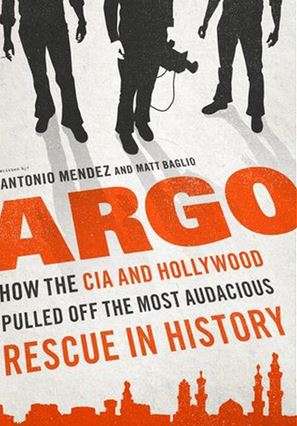










The success of Entebbe relied on a ‘perfect storm’ of intelligence and audacity. In today’s era of satellite surveillance and instant communication, do you think a mission could ever achieve that same level of ‘Zero-Day’ surprise again?