About:
Bytes and Bullets: Global Rivalries, Big Tech, and the New Shape of Modern Warfare by Steve Feldstein is a profound exploration of how cutting-edge, as well as commercial off the shelf (COTS) technologies are rewriting the rules of national security and warfare itself. Mr. Feldstein is a published author, former State Department official, and a senior fellow at the Carnegie Endowment for International Peace.
- 12 hours and 11minutes
- Publisher : Macmillan Audio
- Language : English
- ASIN : B0F6GC16K7
- Narrators: Patrick Cavanaugh
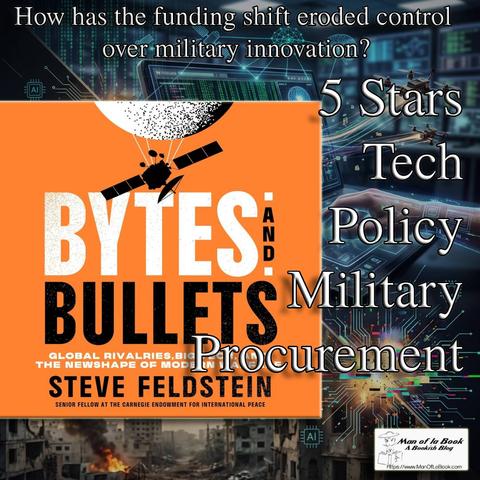
My rating for Bytes and Bullets - 5
Buy Bytes and Bullets from Amazon.com*
More books by Steve Feldstein*
More books narrated by Patrick Cavanaugh*
Thoughts:
An interesting, well-researched, compelling and somewhat unsettling audiobook. This day and age, private high-tech companies can sell software and hardware to the highest bidder, making the superpowers lose the technological edge they've worked for decades to build. These technologies could be dual-use and difficult to contain.
Bytes and Bullets by Steve Feldstein illustrates through fascinating case studies how regional conflicts were reshaped by accessible technology, and remote technologies redefined wars. But technology doesn't have to be expensive Nvidia chips, it could be cheap drones from Amazon which can have just as much impact.
Narrator Patrick Cavanaugh makes this book, which is mainly geopolitical analysis, exciting as any adventure novel. He's easy to listen to and delivers a sharp and authoritative reading matching the tone of the book.
Man of la Book's Margin Notes: The Speed of Modern War vs. Bureaucratic Systems
1. The Core Dilemma: Iteration at the Speed of the Consumer Market
In Bytes and Bullets, Mr. Feldstein highlights the institutional friction and widening latency and lag between traditional defense acquisitions and the delivery of software and hardware. Our institutions and infrastructure operated on procurement schedules that could literarily take decades to bear fruit. These days, however, fielding materiel and software rapidly in active conflict zones is a critical necessity. Adapting COTS technology on the field, such as modifying off-the-shelf drones, and local mesh networks can occur in hours or days, bypassing the traditional process entirely.
Even though this is cutting edge technology, the rapid fielding of materiel is not without precedent. The nature of technology has evolved from industrial manufacturing to cloud computing maybe, but similarly friction has existed previously.
2. The Industrial Precedent
In Freedom's Forge, Arthur Herman writes of how General Motors' William Knudsen and shipbuilder Henry J. Kaiser converted whole commercial factories into the "Arsenal of Democracy" during World War II. The book demonstrates that winning large conflicts requires an adaptive capacity for the private sector, with a flexible and supportive private sector.
Mr. Feldstein's framework might be more modern, but the agility of both sectors is, once again, needed. The output has changed from heavy steel to software and Al models, from heavy bombers and battleships to autonomous drones, but the target for faster deployment is the same.
3. The Modern Bridge
In Unit X, Raj M. Shah and Christopher Kirchhoff write from experience about dealing with the Pentagon's struggle to adopt and procure technologies at speed. The book details the origins of the Defense Innovation Unit (DIU), that was meant to help the government buy cutting edge technologies before they become obsolete.
The authors documented the rigidness of the Pentagon and Congress in contrast to the flexibility of tech startups, and the maze called acquisition regulations. The authors argue, much like Mr. Feldstein, that the traditional procurement model disincentivizes small inhovative companies from working with the government to address issues which are critical to our national security.
How comfortable are you with private Silicon Valley tech companies having the power to influence active military conflicts or foreign policy decisions?
The narratives weaves between historical context, tech forensics, and field reporting flawlessly. I especially enjoyed the way the author traces policy decisions from one administration to the next, or the previous ones which, I thought, added a lot of context to a world where memes many get their news from useless memes. And unfortunately I'm talking about reports as well.
The fact that we live in a world of commercialized, open-source technology means that the tech superpowers cannot simply block our geopolitical rivals in this aspect. Even if we could, modern warfare depends on fielding cheap technological weapons (ex: drones) just as much as those that it took decades to build. In fact, using shooting down a $400 drone with a $50,000 missile is becoming just a war of attrition.
The audiobook delivers a gripping, story-driven narrative told by an author who understands technology and policy and is able to put them in historical and current context. The battles to field technology and rule cyberspace are already being fought, not just in the filed but also in boardrooms and legislative bodies.
Buy Bytes and Bullets from Amazon.com*
More books by Steve Feldstein*
More books narrated by Patrick Cavanaugh*
Zohar — Man of la Book
Disclaimer: I got this audiobook for free
*Amazon links point to an affiliate account, the money is usually spent on books