About:
The Library of Forbidden Books by Mario Escobar is another World War II novel centering on the perceived danger books held on the Third Reich. Mr. Escobar is a best-selling author and historian.
- 368 pages
- Publisher : Thomas Nelson
- Language : English
- ISBN-10 : 1400355826
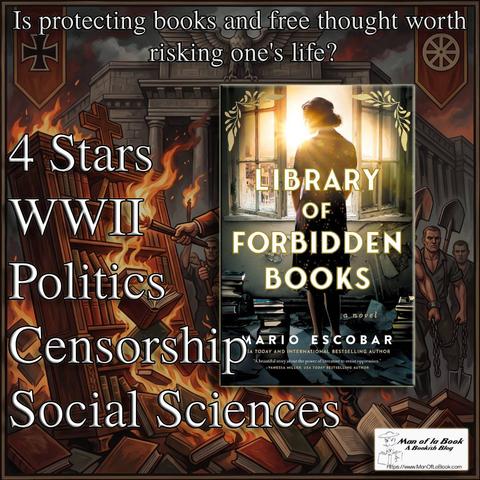
My rating for The Library of Forbidden Books - 4
Buy The Library of Forbidden Books from Amazon.com*
More books by Mario Escobar*
More books by Gretchen Abernathy*
Thought:
Mr. Escobar’s books are ones I’m usually on the lookout for. I enjoyed many of his books previously and the weaving of history in fictional narrative makes them an enjoyable learning experience.
The Library of Forbidden Books by Mario Escobar (translated by Gretchen Abernathy) captures the idea that destroying books is an attempt to destroy history, memory, and education to get a compliant populace. Preserving uncensored knowledge is an act of defiance in this context, and especially in that time.
The book spends a lot of time in the 1930s, capturing fear, neighborly betrayals and censorship all moving in blitzkrieg speeds. These government sponsored acts reshaped the lives of everyday Germans a long time before any bullets were fired.
Like the author’s other books, the historical detail and timeline are accurate and add a lot of background and context to the fictional narrative.
Man of la Book's Margin Notes: The Real Dr. Helene Nathan
Dr. Helene Nathan (23 August, 1885 - 23 October, 1940) was not just a librarian, she was a true visionary. By 1921 she was put in charge of the public library in Neukölln, Berlin (which is still open). At the time, Dr. Nathan was one of the few women in the era to hold such a top position in the library of a major German City.
Dr. Nathan was active in the Social Democratic Party (SPD), and looked at her occupation as an essential tool to help uplift the working class people. She expanded access for youth, and created a dedicated lending branch for children, hence revolutionizing libraries' access to working families.
When the Nazis rose to power in 1933, Dr. Nathan was fired due to her Jewish background, as well as her membership in the SPD. Contrary to the novel, Dr. Nathan endured isolation and persecution while living in Berlin. She tragically committed suicide in 1940.
The memory of Dr. Helene Nathan lives on. There's a commemorative plaque in Ganghoferstraße in Neukölln, and the main district library was named in her honor.
What is a book that has profoundly shaped your way of thinking—one you would risk everything to protect for future generations?
The book not long and hence moves quickly through historical events which other books spend more words on. This allows Mr. Escobar to include some important perspectives such as political maneuvering and yet allows Helene’s story to be at the center of it.
As a bibliophile, this book was not only thought-provoking, but also inspirational. It’s a reminder that we must protect free thought, and an homage to the unsung heroes that are all around us.
Synopsis:
Helene Nathan, a half-Jewish librarian is one of the first women in Germany to rise to be a prominent librarian in a public library. Helene is engaged to a Christian officer in the German army in 1933 when National Socialism’s rise to power begins.
Helene witnesses the attacks against Jews, intellectualism and the burning of books. She takes matters into her own hand, and with a select group of dedicated colleagues attempts to save precious, and some irreplaceable volumes.
Buy The Library of Forbidden Books from Amazon.com*
More books by Mario Escobar*
More books by Gretchen Abernathy*
Zohar — Man of la Book
Disclaimer: I got this book for free
*Amazon links point to an affiliate account, the money is usually spent on books