About:
Biological War: A Scenario by Annie Jacobsen tells of a semi-fictional scenario where an engineered plague outbreaks from a Russian lab and makes it to the USA. Ms. Jacobsen is a published author and a Pulitzer Prize winning journalist.
- 432 pages
- Publisher : Dutton
- Language : English
- ISBN-13 : 979-8217046034
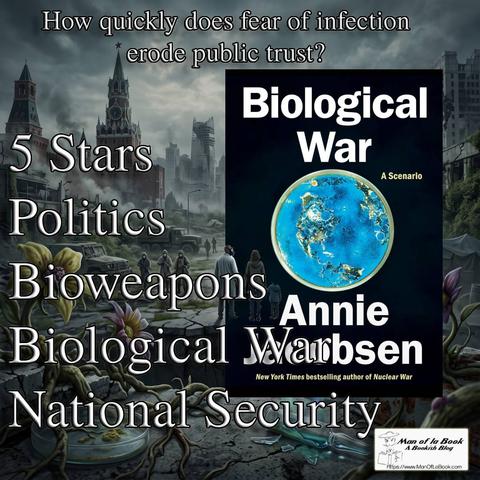
My rating for Biological War - 5
Buy Biological War from Amazon.com*
More books by Annie Jacobsen*
Thoughts:
The book presents a fictional a chilling scenario where Russian lab accident has unleashed upon the world a deadly, state sponsored virus with no known cure. The research is meticulous, and the examination of the cultural and political implications are absolutely fascinating.
Biological War by Annie Jacobsen presents a ticking bomb scenario of hours, days, and weeks after a deadly biological agent has been released upon the world. Ms. Jacobsen interviewed many high-level politicians, scientists, analysts, and military officials. Many of those interviewed have participated in "war games" of exactly such scenario.
Man of la Book's Margin Notes: The Warning Label Paradigm
A Journal of the Plague Year by Daniel Defoe was published in 1722 and presents London's Black Plague through a fictional journal of "H. F.". Mr. Defoe's narrative uses actual death records from local municipalities, medical records, and official proclamations.
Mr. Defoe brings the reader an almost minute-by-minute account of London's collapse during the 1665 Great Plague. Three hundred years later, Annie Jacobsen accomplishes a similar feat using the example of modern, genetically engineered bacteria. Both authors write about a silent killer that uses human delay and institutional denial to its advantage.
1. Structural Parallel: Reporting as Docudrama
In Biological War author Annie Jacobsen used a very similar literary device as Mr. Defoe did. Instead of just presenting the narrative in a dry, academic language, she constructs an exciting narrative based on actual contingency plans, cutting edge research, and experts. It is difficult to convey the sheer magnitude of such world-shaking events, when you think about it, it either doesn't make sense, or we simply don't want to acknowledge it's happening. Blending fact-based information with a chronological progression through storytelling is an excellent way to convey such information.
2. The Invisible Enemy and the Lag in Perception
One of Mr. Defoe's themes is that human complacency creates a delay in response which, in cases such as these, is fatal. While the plague ravaged 1665 London, business, commerce and social life continued unabated since the plague's incubation period allowed individuals to socialize unnoticed.
Ms. Jacobsen's work highlights a similar dynamic. Unlike a conventional or nuclear war, where the effects are unmissable, a biological attack, or even a lab leak, can make its way around the world unnoticed. By the time medical authorities recognize, and able to form a response to the outbreak, exponential infection has already occurred across continents making containment, for all intents and purposes, impossible.
3. Institutional Breakdown and Human Behavior
Both Mr. Defoe and Ms. Jacobsen examine the unbelievable speed in which a fatal threat can break down societal infrastructure and destroy governance plans that have been planned for decades.
Mr. Defoe observed the breakdown of city services, quarantining of entire houses, and widespread panic. The complete collapse of economic order as Londoners flee or turn on one another is a fascinating and engrossing account, which I could certainly see happening today.
Ms. Jacobsen's scenario deals with modern supply chains, hospital capacities, and the response of emergency personnel and systems. In this scenario, military readiness crumbles within days when the engineered plague strain takes a hold on society.
4. Literature as a Cautionary Warning
Both books, A Journal of the Plague Years and Biological War ride a fine link between entertainment and terror. Both are a warning that society and our leaders would be smart to listen to.
Mr. Defoe wanted to warn about the future. The unpreparedness of public health and administrative denials were a large part of why so many Londoners die.
Ms. Jacobsen's narrative attempts to shift the focus of current policymakers to the vulnerabilities the public faces from synthetic biology, and biodefense research. Our global response systems are fragile, inadequate, and institutional habits of underestimating the populace and lying in attempts to calm people down will not just fail, but backfire.
The author tells of a fictional story but uses facts to analyze what the outcomes would almost certainly be. She even uses COVID as examples of how the virus could easily spread, and what would happen if it would have been much more deadly. I couldn't stop thinking about the few Zombie (a plague for all intents and purposes) movies I watched, and how eerily accurate the portrayal of societal breakdown is, especially World War Z.
It might be read like a science fiction book, but it is rooted in painstaking research. The vulnerability is in humans, as it seems like its always is. When a danger of such magnitude happens, and the government falters, people feel like they're all alone and all societal norms break down quicker than anyone of us might realize. We've seen it happen before, and I hope we'll never see it again.
Buy Biological War from Amazon.com*
More books by Annie Jacobsen*
Zohar — Man of la Book
Disclaimer: I bought this book
*Amazon links point to an affiliate account