About:
Fixer Chao by Han Ong is a literary satire about a man who pretends to be a Feng Shui master to the NYC elites. Mr. Ong is a novelist, playwright born in the Philippines and moved to the US as a teenager.
- 416 pages
- Publisher : Outsider Editions
- Language : English
- ISBN-10 : 0385552114
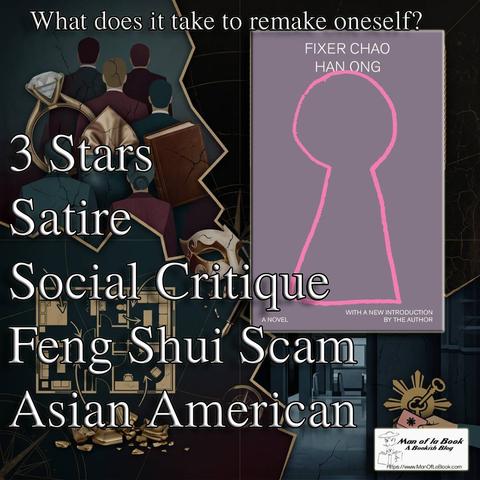
My rating for Fixer Chao - 3
Buy Fixer Chao from Amazon.com*
More books by Han Ong*
Thoughts:
I found the book to be a clever satire, punchy but only moderately funny. I've read, and seen, other similar works poking fun at the excess, pretentiousness, and disconnect of elitists, and how some "street urchin" fools them all.
One of the common aspects to many of these stories is that the narrator, usually the person doing the hustle, acts as the common-man observer. People who are so bored and unhappy, that they turn to a charlatan who promised to fix their lives by.... changing their furniture around.
The elites, those who many of us look up to, are easily fooled when a trend is packaged in mystery. In this case Feng Shui presented by a mystic who promises social prestige. This is especially true when they view Eastern spiritual concepts through the lenses of a wealthy Western, whose vanity and greed seem to be noble goals.
Man of la Book's Margin Note: Social Engineering in Silk Robes
Hacking computers from a technical standpoint isn't as complicated as most people think.
Many can write a malicious script in a few minutes, and a bad one in less than an hour. The most difficult part, however, is getting someone to click on a link-hacking humans is the hard part.
Reading Fixer Chao I couldn't overlook the equivalent of his scam to a social engineering campaign. There are many videos online with social engineers at work, and they are amazing and scary at the same time. Much like the infosec industry, William Narciso Paulinha doesn't need to master a specific skill, Feng Sui in his case, but only to understand the specific vulnerabilities that his targets have..
1. Pretexting via Exotic Authority
A bad actor will try anything, including impersonating someone from your company to gain your network credentials ("Hi, this is Dan from the Help Desk, we noticed your computer is not updated"). People are often conditioned to accept authority without verification, they're so worried about being kicked off the network that they don't bother to verify who they're speaking to.
William's customers, with a bit of critical thinking, would have realized his a fake (for one, he's Filipino, not Chinese), but let their fascination and hubris take control of their actions.
2. Exploiting Latent Guilt
Social Engineering relies, almost entirely, on people making bad decisions. That could be done in several ways such as feigning urgency (click now to get 40% off), fear (your bank account has been hacked), and more. William's clients seem to suffer from some sort of subconscious guilt due to the privilege they have either inherited or acquired through cutthroat methods. "Master Chao" is not only a savior, but also their confessor (it helped that they think he doesn't speak English). They crave absolution and hence invite him into their lives.
3. Subtle Sabotage
Shem guides William to create a slow scam. Intentionally mass up the client's furniture arrangements in small, mostly unnoticeable, increments. William is Shem's Trojan Horse, his Feng Shui that looks safe and useful, but hides a malicious intent (malware hidden in legitimate software). By slightly arranging mirrors, doorways and furniture "off by just a few degrees" they create small, easily missed configuration errors. Like malware, introducing slow-acting errors which, when compounded, could ruin systems or lives.
Have you read any other books where a street-smart outsider manages to completely fool high society?
What is it about con artist/impostor stories set in places like Manhattan that makes them so captivating to read?
William, the protagonist, realizes that his contempt shouldn't be directed solely, or at all, at his clients, but at Shem, the man who planned the scam. He found himself having many things in common with New York's upper class, and that regardless of riches, many of us face the same struggles of being overlooked, thrown aside, and unseen by our peers.
The clients, William realizes, also suffer from "imposter syndrome". None of them, William including, feels that they belong among the literary elites and exploit others to climb up the social and economic ladder. Imposter syndrome is a real thing, which I discover is true in many aspects of life, not just the IT industry.
Synopsis:
William Narciso Paulinha is a poor Filipino immigrant, struggling to make a living in one of the most expensive cities in the world, New York. He crosses paths with Shem, a struggling writer that hates Manhattan's literary elites.
Shem comes up with a scam to humiliate those upper-crust socialites that anubbed him. William is hired by Shem to scam and exact revenge by pretending to be "Master Chao", a Feng Shui master. Their goal, however, is to arrange their homes for harmony, but purposefully mass up some crucial details to ruin their lives in a very subtle way.
Master Chao's success makes him a local celebrity, but William finds himself starting to resent his ostentatious, pompous clients. Soon he starts to see, firsthand, the consequences of his actions.
At its core, Fixer Chao's ultimate lesson is that our greatest vulnerability is our own need for status symbols. When NYC's elites were desperate to appear enlightened, William and Shem's con succeeded with little, if any, scrutiny.
Buy Fixer Chao from Amazon.com*
More books by Han Ong*
Zohar — Man of la Book
Disclaimer: I got this book for free
*Amazon links point to an affiliate account, the money is usually spent on books