About:
The Wolves We Feed (Book 1 of The Path to the Mists of Oblivion) by Stein J. Rubach is an ambitious historical fiction family saga taking place in pre-World War I Europe. Mr. Rubach is a Norwegian author, this is his first novel.
- 444 pages
- Publisher : Independently published
- Language : English
- ISBN-13 : 979-8250468145
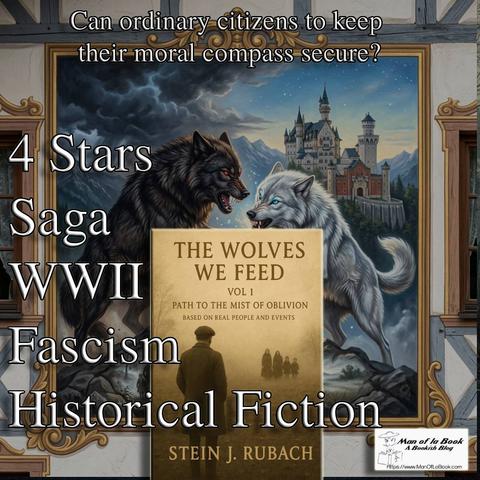
My rating for The Wolves We Feed - 4
Buy The Wolves We Feed from Amazon.com*
Books in The Path to the Mists of Oblivion series*
More books by Stein J. Rubach*
Thoughts:
An interesting book that is immersed directly in the center of polarized Europe in the late 1800s and early 1900s. The two brothers, like two wolves, fight for dominance between anger and greed, or peace and compassion.
What I liked about the book is the biographical realism showing that fascism was built brick by brick through individuals' choices and did not happen overnight. The historical realism of the book was disconcerting to read these days, where some events rhyme in today's society, and others could actually be under the "ripped from the headlines" category.
The narrative is slow moving, the political atmosphere is meticulously built, like a slow-moving avalanche which you watch, knowing it will slowly take over. The loud fascists bent on grabbing power through destruction easily crush those who must hide to survive.
Man of la Book’s Margin Notes: The Two-Wolves Algorithm
From an analytical and software assurance standpoint, Mr. Rubach's narrative operates on a classic, recursive psychological parable applied directly to an entire civilization.
1. The Brother-As-Mirror Vulnerability
The core thematic engine relies on a brilliant juxtaposition: two German brothers sharing the exact same genetic source code and early environment. One shifts into a primary architect of fascism, while the other launches high-risk, covert rescue missions to protect the innocent.
Rubach uses this familial sandbox to run a controlled experiment on human nature. It proves that institutional corruption and radicalization are not inevitable system defaults, but rather the result of a user continuously feeding malicious parameters into their own behavioral logic layer.
2. The Multi-Tenant Network
By tracking three families from completely different cultural and socio-political background logs (Göring, Löwenthal, and Odeska), the novel simulates a hyper-connected network on the brink of a total crash.
Love, ambition, and betrayal serve as the data packets traveling between these households. As the rising tide of fascism introduces malware into the European ecosystem, the "firewalls" protecting these personal relationships experience severe degradation, demonstrating how macro-historical shifts inevitably corrupt individual security sandboxes.
3. The Balance of Power Within
The title itself taps into the immortal parable of the two wolves locked in an internal fight—one representing light and compassion, the other darkness and ego.
Rubach's brilliant mechanical stroke is showing how a totalitarian state actively optimizes for the dark wolf, subsidizing anger and prejudice through systemic laws. To feed the light wolf in such a compromised environment requires a massive expenditure of personal energy, turning basic acts of human decency into radical, asymmetric warfare against the state apparatus.
There are many individuals in the book, some with the same name and similar, it was very easy for me to get lost when it came to who's who. That's too bad, because The Wolves We Feed by Stein J. Rubach is a thought-provoking book, still relevant even if the events took place almost 150 years ago.
The book succeeds in interweaving the three families across time and space. The street level choices that people made to embrace Nazism and throw the world into a catastrophic calamity are shown in a slow moving, horrifying manner.
Synopsis:
The storyline follows three families: the Görings, the Löwenthals, and the Odeskas whose destinies will become interconnected. The book mainly follows two German brothers as they live through the rise of fascism in their own country.
The older brother sees the decent of his country as a cartoonish villainy, but embraces the strength that comes with it and helps architect Nazism. Meanwhile the young one is feeling the dread of the inevitable, suffering the lack of support from his nation and people.
Buy The Wolves We Feed from Amazon.com*
Books in The Path to the Mists of Oblivion series*
More books by Stein J. Rubach*
Mr. Rubach illustrates a chilling reality: in a world surrendering to fear, feeding the 'wolf of light' isn't a passive state of mind—it requires an active, high-risk defiance of the prevailing social infrastructure. When analyzing our modern echo chambers, are we currently building digital and cultural systems that feed our worst internal impulses, or are we actively supporting the infrastructure of empathy and reason?
Zohar — Man of la Book
Disclaimer: I got this book for free
*Amazon links point to an affiliate account, the money is usually spent on books













Mr. Rubach illustrates a chilling reality: in a world surrendering to fear, feeding the ‘wolf of light’ isn’t a passive state of mind—it requires an active, high-risk defiance of the prevailing social infrastructure. When analyzing our modern echo chambers, are we currently building digital and cultural systems that feed our worst internal impulses, or are we actively supporting the infrastructure of empathy and reason?