Graham Greene (2 October, 1904-3 April, 1991) was an English author, playwright and critic.
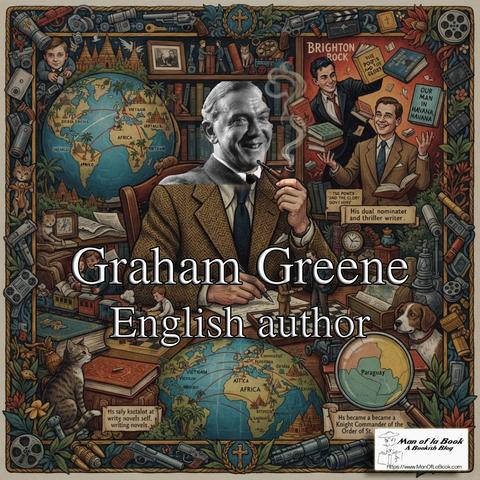
Fun Facts about Graham Greene:
1. Henry Graham Greene was born in Hertfordshire, England. His father, Charles Henry Greene was the house master of the boarding house where he was born. His mother, Marion Raymond Greene, was his father’s first cousin.
2. Mr. Greene’s brother, Hugh Carleton Greene became the Director-General of the BBC, another brother, Charles Raymond Greene was a notable physician and mountaineer. Famous author Robert Louis Stevenson was his grandmother’s cousin.
3. He published his first book, Babbling April, while an undergraduate at Balliol College, Oxford.
The book was not successful and did not receive good reviews. While in school he started corresponding with Vivien Dayrell-Browning, who wrote him with corrections on Catholic doctrine. They fell in love and after he was baptized, the got married in London.
4. After graduation, Mr. Greene was as a tutor and a journalist, eventually becoming a sub-editor (copy editor) of The Times.
5. Graham Greene’s The Man Within, his first novel was published in 1929 and was well received. He left his sub-editor job to write full time. However, his next two novels, The Name of Action (1930) and Rumor at Nightfall (1932) did not become a success. But in 1932 he found success again with Stamboul Train (the book was adapted into a 1934 motion picture called Orient Express).
6. Mr. Greene liked to travel to remote places, and was eventually recruited to M16 by his sister, Elisabeth in 1941. He was stationed in Sierra Leone during World War II. His supervisor and friend was notorious double agent Kim Philby. He even wrote the introduction to Philby’s memoir My Silent War (1968).
In 1944 Mr. Greene resigned from the agency, but turned his experience into a comedic novel, Our Man in Havana, in which the spy fakes his reports by drawing vacuum cleaner parts.
7. In 1940 Mr. Greene published his Hawthornden Prize winning novel The Power and the Glory, which became controversial 13 years later when it was condemned by the Holy Office for being “paradoxical”. The novel deals with a renegade Catholic priest (whiskey priest as the author calls him), live in Tabasco, Mexico during the time the government as attempting to suppress the Catholic state. However, Pope Paul VI told the author in 1965 that “some aspects of your books are certain to offend some Catholics, but you should pay no attention to that”.
The novel is considered to be Graham Greene’s best work.
8. Mr. Greene moved to Switzerland in his later years where he struck a friendship with one of his neighbors who happen to be Eugene O’Neill’s son in law, an actor named Charlie Chaplin.
9. Along with books, articles and criticism, Mr. Greene also wrote 11 screenplays. The screenplay he adapted in 1959 from his novel The Third Man is still considered to be one of the greatest movies made in England.
10. Even though he was nominated and shortlisted for the Noble Prize many times over several decades, he never won. This is considered to be one of the biggest snubs in the history of the prize. However, the brewery his great-grandfather founded, the Greene King Brewery, produced a special ale with his picture on it for his 80th birthday. Not as prestigious but certainly a worthy honor.
Zohar — Man of la Book
*Amazon links point to an affiliate account
Sources:
Graham Greene – Wikipedia
A Life on the World’s Edge: Graham Greene (1904-1991) | Time
Graham Greene – his life and work | Graham Greene Birthplace Trust
Happy Birthday, Graham Greene | Dappled Things