About:
Suicidal Empathy: Dying to Be Kind by Dr. Gad Saad is a cultural critique on The West's overly sympathetic attitude towards those who clearly say they want to destroy it. Dr. Saad is a Lebanese refugee, now a Canadian physiologist and author.
- 256 pages
- Publisher : Broadside Books
- Language : English
- ISBN-10 : 0063446537
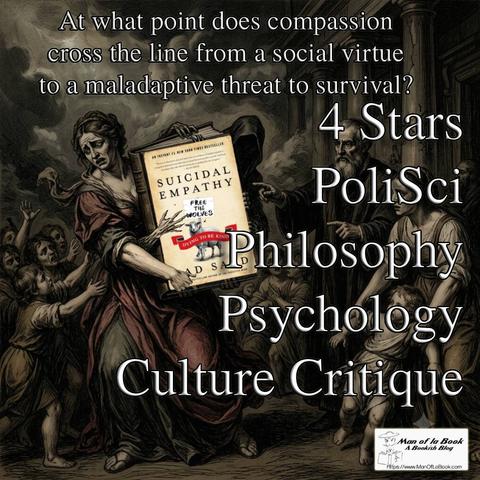
My rating for Suicidal Empathy - 4
Buy Suicidal Empathy from Amazon.com*
More books by Gad Saad*
Thoughts:
The book's premise, that I happen to agree with, is that many Western countries are turning inward, actively working towards their own demise. The book challenges modern progressive policies, with wit, or attempted wit, and sensible reasoning.
Suicidal Empathy by Dr. Gad Saad argues that the strict guardrails needed for people and societies to remain functional have been broken in Western countries. These policies value offenders over victims, blaming society at large while stopping to be humane even though the intention is otherwise.
The book does not mince words, Dr. Saad diagnoses these policies with aggressiveness and I snot afraid to be confrontational. The narrative forces the reader to differentiate between feel-good polices and the realities of the world. The topics are not just about the Muslim takeover of Canada and Europe, as one would expect, but also touches on criminal reform, and activism at large.
What the good Dr. is implying, but not saying, is that often doing good does not feel good. Any parent who had to discipline a child, or a person walking by a beggar without giving money knows that feeling.
He feels that in this hyper-connected, globalized world, bad actors have effectively relabeled bad behavior as "victimhood", bypassing people's rational defense and survival mechanisms. Doing so people allow themselves to tolerate ideologies which degrade the safety of themselves, their families, and society. According to Dr. Saad, the compassionate policies do more damage than good, but they sure do feel good to support and implement.
Man of la Book’s Margin Notes: The Disinformation & Self-Sabotage Matrix
I have been trying to understand the subjects exposed in Suicidal Empathy without having to get a PhD in psychology. I turn to other subjects which I know more about, technology and history. I decided to look past the cultural culture wars and analyze it as a failure of a society's Information Security Architecture. When the guardrails of critical-thinking are bypassed, misinformation transforms from a simple data error into a weapon that causes people, and entire institutions, to actively participate in their own destruction.
1. Saad vs. James B. Stewart’s Tangled Webs
Dr. Saad explores how emotional misinformation causes people to break their own societal guardrails out of a desire to "feel kind," James B. Stewart’s Tangled Webs: How False Statements are Undermining America looks at a more deliberate, structural assault on our normalized culture of lying under oath.
Stewart examines high-profile perjury cases—from Martha Stewart to Scooter Libby—demonstrating how public figures willingly destroy their own lives, careers, and reputations by doubling down on verifiably false assertions. When placed alongside Suicidal Empathy, a terrifying pattern emerges. In both frameworks, individuals willingly self-sabotage. In Stewart's book, they do it out of hubris and a belief that they can successfully spoof the legal system; in Saad's book, they do it because their ideological programming convinces them that denying reality is a moral virtue. Both track the severe degradation of institutional input validation.
2. Saad vs. Nina Jankowicz’s How to Lose the Information War
What does Nina Jankowicz’s How to Lose the Information War War has to do with Dr. Saad’s psychological thesis?
Ms. Jankowicz writes, in some detail, how the United States’ geopolitical adversaries, particularly Russia, deploy targeted disinformation campaigns across Western nations. The overlap with Dr. Saad’s thesis cannot be overlooked: foreign intelligence operations do not create divisions between us; they find existing divisions, mainly with super-empathetic or super-partisan social justice narratives—and use them as the wish without them knowing that their “original ideas” have been planted. Ms. Jankowicz’s book overlaps with Dr. Saad’s by showing how Western democracies are committing “Suicidal Empathy” because we are addicted to viral, emotionally volatile misinformation / disinformation campaigns that we will willingly destabilize our own elections and civic trust just to validate our tribal biases. Saad IDs the internal bug; Jankowicz shows how foreign actors exploit it.
3. Saad vs. Richard Stengel’s Information Wars
Richard Stengel’s book Information Wars: How We Fought Cyber Attacks, Propaganda, and Fake News Before the State Department, looks at misinformation / disinformation from a level in the upper echelons of government. Mr. Stengel, former Under Secretary of State, writes about combating weaponized narratives on the global stage. He argues that we are living in a post-truth era where state-sponsored disinformation is deliberately engineered to make citizens lose faith in the very concept of objective reality.
When looking at both Mr. Stengel and Dr. Saad’s works, the tragedy of "suicidal empathy" becomes crystal clear. Mr. Stengel shows how a society that fails to defend the integrity of the space of information and basically surrenders its sovereignty without a single shot being fired. When citizens are conditioned by the cultural forces Dr. Saad describes to value narrative over evidence, they become completely defenseless against the sophisticated psychological warfare that Mr. Stengel’s book documents. They will happily degrade their own nation's security, fully believing they are operating on the side of global righteousness.
The most interesting part of the book is when the author, an evolutionary psychologist, highlights the ideological echo chamber which goes into high gear whenever reality contradicts the empathetic narrative. If reality is not empathetic enough, people just ignore it guided by misplaced compassion making recovery almost impossible.
The last few sections of the book, however, had me puzzled. Dr. Saad starts complaining about unfair tax policies, Canada's healthcare system, and other personal vendettas I believe readers don't care about. I could feel Dr. Saad's passion about the subject though, he is very concerned about these policies and is not shy about them. If you're looking for a data-driven, clinical Il read this is not it.
Buy Suicidal Empathy from Amazon.com*
More books by Gad Saad*
Dr. Saad argues that evaluating policies based on the 'good intentions' of their authors rather than their real-world outcomes is a form of civilizational suicide. Looking at our modern public institutions, how do we build better 'output filters' that hold leaders accountable for actual results instead of just public moral posturing?
Zohar — Man of la Book
Disclaimer: I bought this book
*Amazon links point to an affiliate account, the money is usually spent on books













Dr. Saad argues that evaluating policies based on the ‘good intentions’ of their authors rather than their real-world outcomes is a form of civilizational suicide. Looking at our modern public institutions, how do we build better ‘output filters’ that hold leaders accountable for actual results instead of just public moral posturing?