Adam Smith (5 June, 1723-17 July, 1790) was an economist and philosopher from Scotland, known as the “Father of Modern Economics” due to his book, The Wealth of Nations.
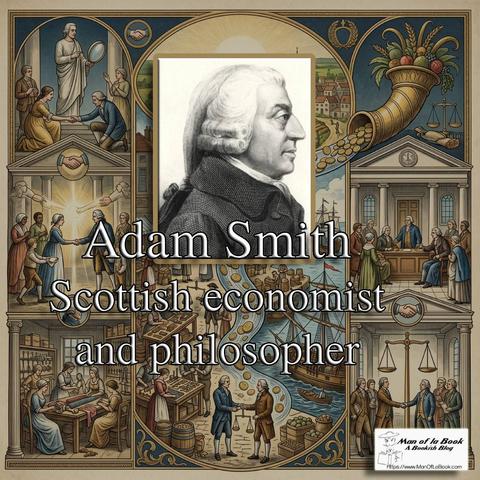
Fun Facts about Adam Smith:
1. Adam Smith was born in Kirkcaldy, Fife on the east coast of Scotland. He studied social philosophy at the University of Glasgow and in Oxford on a scholarship from John Snell, one of the universities founders.
2. Mr. Smith was known to fall into deep trances mid-sentence, talk to himself in public, and just general absent-mindedness. Once he even walked 15 miles without noticing he was still wearing his nightgown. Another anecdote tells of the time he brewed beat and butter and went on to complain it was the worst tea he ever tasted.
3. Despite these outer distractions, his mind was sharp and possessed an amazing ability to store information. He could quote large passages from both literary and philosophical works from memory, and on demand.
4. Adam Smith never married, and lived most of his life with his mother, Margaret Douglas. He was very devoted to her until her death.
5. He was a very popular professor teaching moral philosophy at the University of Glasgow. In fact, we know of students who traveled from across the European continent specifically to hear his lectures.
6. Adam Smith’s 1759 book The Theory of Moral Sentiments is about ethics and human empathy. To this day it’s considered superior to his most famous work, The Wealth of Nations.
7. The Wealth of Nations, published in 1776, completely changed the way people converse about economic issues such as trade, self-interest, and labor. The book took him over a decade to write and sold out in six months. Which was amazing back then, and would even be amazing today for a dense, academic work.
8. He is also well known for creating the concept of “the invisible hand”. However, across all his decades of writing he only used the phrase 3 times: once in The Theory of Moral Sentiments, once in The Wealth of Nations, and once an essay about astronomy. At the time though, economics was considered to be a branch of moral philosophy (“political economy”) which focused on the best ways a society could provide for its citizens.
I have heard many economists today still say that their field is “an art masquerading as science”.
9. Despite arguing for free trade and minimal government interference, he spent years working as a Commissioner of Customs in Edinburgh. The job included collecting tariffs and taxes, write about what you know… I guess.
10. Benjamin Franklin, Thomas Jefferson, and Alexander Hamilton all studied The Wealth of Nations while shaping the economic framework of the new country they were building.
Zohar — Man of la Book
*Amazon links point to an affiliate account
Sources:
Adam Smith | Wikipedia
Adam Smith: Biography, Books, Capitalism, Invisible Handd | Britannica