About:
The Children by Melissa Albert follows a brother and sister, from a dysfunctional family, that their mother used their actual names in a successful fantasy series she wrote. Ms. Albert is a best-selling author and blogger whose books have been translated to many languages.
- 416 pages
- Publisher : William Morrow
- Language : English
- ISBN-10 : 0063487438
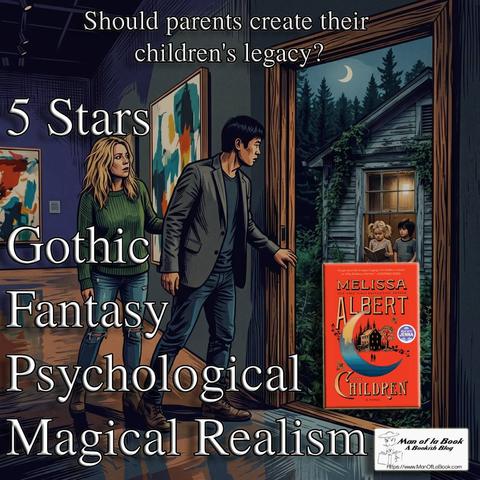
My rating for The Children - 5
Buy The Children from Amazon.com*
More books by Melissa Albert*
Thoughts:
I must admit that at first I didn't care about the book. I was on vacation and it's not a "vacation book". But once I got home, it really kicked in and it was difficult to put down.
I also must admit that The Children by Melissa Albert screwed with my head a bit. Fractured childhood memories, and blurred lines between reality and fiction are something that, I believe, most of us experience when thinking or reevaluating our childhood.
Man of la Book's Margin Note: The Cost of Becoming Intellectual Property
I found a tragic commonality between Melissa Albert's fictional Guinevere and Ennis and real-world historical children like Christopher Robin Milne, Alice Liddell, and Lucy Barfield.
When a living child is used as the "Source Code" for a literary character, a permanent Logic Conflict is introduced into their life. The public-facing "avatar" (the literary character) often completely overwrites and eclipses the actual, flesh-and-blood child.
1. Christopher Robin Milne: The Vulnerability of the Nameless Avatar
In the case of Christopher Robin Milne (son of A.A. Milne), the vulnerability was an absolute breach of identity privacy. His father didn't just use his likeness; he used his actual name.
As Christopher Robin grew up, his real-life "production environment" was constantly disrupted by the massive public "traffic" of the Winnie-the-Pooh franchise. He famously remarked that his father had achieved success by climbing upon his infant shoulders, filching his good name, and leaving him with nothing but the empty fame of being his son. Like Ennis in The Children, Christopher Robin faced an intense psychological battle to "defragment" his true self from the commodified, soft-natured boy in the poems.
2. Alice Liddell: The Distorted Mirror
Alice Liddell, the inspiration for Lewis Carroll’s Alice’s Adventures in Wonderland, experienced a different kind of system distortion. Carroll took her identity and injected it into a surreal, chaotic landscape governed by nonsense logic.
While the literary Alice was bold and adventurous, the real Alice had to carry the heavy "metadata" of the public's endless curiosity for the rest of her life. She was permanently locked into a specific version of her childhood, forced to perform as "the real Alice" well into her old age to satisfy the demands of the fandom ecosystem.
3. Lucy Barfield: The Air-Gapped Muse
Lucy Barfield, C.S. Lewis’s goddaughter and the dedication recipient of The Lion, the Witch and the Wardrobe, represents a quieter, tragic parallel. While Lewis named the heroic, deeply empathetic Lucy Pevensie after her, the real Lucy Barfield suffered from severe, debilitating health issues later in life and lived in relative obscurity.
For her, the brilliant, magical "Ninth City" equivalent was Narnia—a flawless, immortalized version of childhood grace that stood in stark, painful contrast to the fragile, human hardware of her actual reality.
4. Guinevere and Ennis: The Malicious Upgrade
What separates Melissa Albert's characters from these real-world historical muses is the sheer malice and neglect built into their system architecture.
- Commodification of Abuse: A.A. Milne and Lewis Carroll, whatever their complex motivations, created worlds of comfort. Edith Sharpe, conversely, used her children as raw data while completely failing to provide basic administrative support (food, sanitation, safety) in their physical sandbox.
- The Weaponized Legacy: While Christopher Robin could eventually walk away from Pooh Corner, Guinevere and Ennis find that their mother's "Ninth City" isn't just an abstract story on a shelf. It is an active, aggressive legacy system that continues to run background processes in their adult lives, threatening to overwrite their survival entirely.
Ultimately, whether in reality or Gothic fantasy, transforming a child into a permanent literary monument acts as a systemic trap. The world falls in love with the unaging, immutable code of the character, leaving the actual human being to rot in the margins of their own biography.
I have never read any of the author's books, but was very impressed with the ornate, Gothic writing style. It's dense, eerie, but readable and beautiful at the same time. Ms. Albert also manages to move between timelines very smoothly, where the future references the past, and somehow the past references the future.
Guin built her whole life quarantining memories, running away from her childhood. When her brother shows up in her sphere again, her psychological firewalls break down, forcing her to face reality. As the story progresses, however, it seems that her mother's creation, the Ninth City, might not have been entirely fictional. Just like the most of humanity, Guin must face the terrifying truth is that her parent's world, real or imagined - it doesn't matter -still has an active, physical hold on the next generation.
The core of the book is the way art can influence people and stay with them. Most of the time, let's face it, it's the art which brings darkness that has the most influence and stays with us the longest- and this book captures it beautifully.
Synopsis:
Guinevere and Ennis Sharpe grew up in the shadow of their famous mother. In the secluded Vermont farmhouse, Mrs. Sharpe wrote her world famous Ninth City books, where two kinds named... Guinevere and Ennis Sharpe go through magical adventures.
Now an adult, Guin, still in the shadow of her famous mother, is promoting her ghost-written biography. Mid interview, live on TV, she finds out that her brother, now an artist, has created a new exhibition about "Mother". Guin coolness begins to crack as memories come back, and fantasy starts to mix with reality.
Buy The Children from Amazon.com*
More books by Melissa Albert*
Christopher Robin Milne famously resented his father for turning his childhood into a commercial empire. When we look at modern 'kidfluencers' and family vlogs, are we seeing the digital evolution of this exact same vulnerability—where parents overwrite their children's real lives with a curated, profitable narrative package?
Zohar — Man of la Book
Disclaimer: I got this book for free.
*Amazon links point to an affiliate account, the money is usually spent on books