About:
Wounded Knee: Party Politics and the Road to an American Massacre by Heather Cox Richardson explores that events that allowed the Wounded Knee massacre to happen. Mrs. Richardson is a historian, published author, and on-line persona.
- 392 pages
- Publisher : Basic Books
- Language : English
- ISBN-10 : 9780465025114
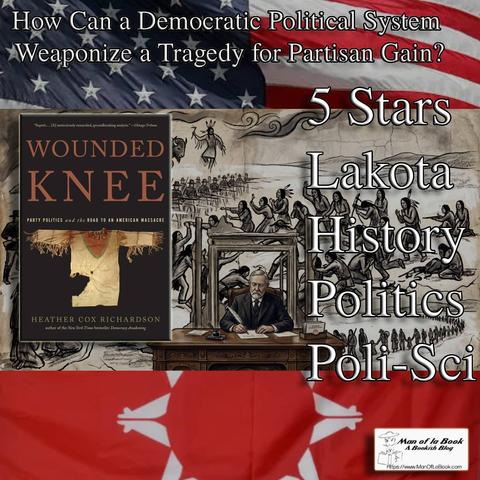
My rating for Wounded Knee - 5
Buy Wounded Knee from Amazon.com*
More books by Heather Cox Richardson*
Thoughts:
This book is a brilliant analysis of how the United State's political system in the 1890s gave implied permission for the massacre to take places. The author shows how this disaster was manufactured for political gain.
Wounded Knee by Heather Cox Richardson makes the case that the lives of Native Americans were traded for votes during an election year. The Benjamin Harrison administration was trying to distract voters from the midterms. The Republican party was facing huge losses and in order to distract voters they manufactured, with a sensationalist press, an internal enemy in the form of the Lakota.
The Native Americans created a new religion, marked with a Ghost Dance, a spiritual celebration. The administration created the atmosphere for the massacre by labeling the Ghost Dance as a security threat, and later actively worked to manipulate public perception after the tragedy has been publicized. The Indian agents were replaced by political cronies who were unqualified for the position. The deployed troops were there as political pawns for politicians to look strong.
Man of la Book's Margin Note: Political "Logic" of a Tragedy
Heather Cox Richardson’s core argument exposes how a political party managed a crisis to manipulate public perception.
1. Fabricating a System Threat
In 1890, the Republican party was facing massive losses in the midterms. To distract voters and justify their policies, politicians and a sensationalist press manufactured a "security threat." They took the peaceful, spiritual Ghost Dance movement of the Lakota and coded it as a violent "uprising." It was a classic case of distorting raw data to fit a specific political narrative.
2. Corrupting the Local Administration
The "access controls" on the reservations were shattered when the Harrison administration replaced experienced, empathetic Indian agents with political cronies as rewards for party loyalty. These new agents panicked, misread the local environment entirely, and called for military intervention—effectively introducing a massive payload of violence into a tense but stable situation.
3. The Failure of Oversight
The presence of the U.S. Army at Wounded Knee was an operational failure driven by political optics. Troops were deployed not because they were needed, but because politicians needed to look "strong" to their constituents. When communication broke down on that freezing December morning, the resulting violence was the tragic, predictable outcome of a system operating under malicious instructions.
The book changes the whole narrative around the American West. The battlefield is not the focus here, but the halls of power. From Congregational offices, the party headquarters the greed and incompetence of both elected and appointed bureaucrats is staggering.
The author slowly buy surely exposes the machinery behind the history and the ways decisions, or indecision, taken thousands of miles away can turn a protective force into an attacking one. Mrs. Richardson meticulously connects the dots between tariffs politics, electoral votes (in the form of admission of Western states to the Union), and military records to make her case.
Buy Wounded Knee from Amazon.com*
More books by Heather Cox Richardson*
Richardson illustrates how politicians in 1890 used fear-mongering and a partisan press to create a fake national security crisis for electoral gain. Looking at our modern media landscape, do you think our public 'security filters' have improved, or are we still just as vulnerable to having historical narratives manipulated by political machinery?
Zohar — Man of la Book
Disclaimer: I got bought this book
*Amazon links point to an affiliate account, the money is usually spent on books












Richardson*
Richardson illustrates how politicians in 1890 used fear-mongering and a partisan press to create a fake national security crisis for electoral gain. Looking at our modern media landscape, do you think our public ‘security filters’ have improved, or are we still just as vulnerable to having historical narratives manipulated by political machinery?