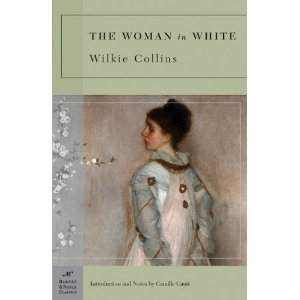
Article first published as Book Review: The Woman in White by Wilkie Collins on Blogcritics
About:
“The Woman in White” by Wilkie Collins was published as a newspaper serial in 1859. In 1860 a collected edition of the chapters was published in book form. The fictional story is considered to be one of the first mystery novels, as well as one of the finest.
- 672 pages
- Publisher : Barnes & Noble Classics
- Language : English
- ISBN-10 : 1593082800
My rating for The Woman in White – 4
How fine you ask? Buy “The Woman in White” and find out*
More books by Wilkie Collins*
Thoughts:
Even though this is a Victorian novel, it is still gripping, engaging and a page turner. The characters created by Collins are three dimensional, vivid, intelligent, thought provoking and sometimes hilarious even by today’s standards. The story is not told in a straight narrative form, but rather in a series of letters, first hand accounts, diaries and dispositions by the main characters, as well as some supporting characters.
Since this novel was first serialized, every chapter ends with a twist to keep the readers coming back, that is not to say that there aren’t many twists in the chapters themselves. As a detective novel, the narrative is faithful to the art of investigation. Walter Hartright, the one who is doing the investigation, doesn’t only talk to witnesses, but also minor characters who can give him background on those he is investigating.
However, “The Woman in White” is not a only a mystery but also a Gothic romance where a man and woman give up almost everything to be together. The author moves the story precisely, gracefully and with wonderful prose and a narrative style which reminded me of Charles Dickens. The plot is complex, twisted engaging yet realistic and easy to digest.
One of the most wonderful things about this book is the fantastic supporting cast. Count Fosco, the main villain, is a Victorian Tony Soprano, with the same charm, body type and villainous and cunning initiatives. Frederick Fairlie, an effeminate hypochondriac, had me laughing out loud, as well as the first several appearances of the Italian Professor Pesca.
Synopsis:
Walter Hartright, a drawing teacher, is hired to teach the beautiful Laura Fairlie and her half-sister Marian Halcombe. Laura is a weak creature, heir to the family fortune while Marian is a strong minded individual. Soon Walter and Laura fall in love, however Laura has already promised Sir Percival her hand in marriage. Soon it becomes clear that Sir Percival has money problems and has his eye on Laura’s money. Not a man of honor, Sir Percival and his friend, Count Fosco, plan to get their hands on the treasure pot.
When Walter and Marian realize that Laura’s life is in danger, the two uncover the dastardly scheme in an attempt to rescue the young bride. Throughout the book, a mysterious lady in white wanders in and out of the story, lonely, dejected and desperate to meet with Laura.
A book which was never out of print must be good
Buy it here before… it goes into print again*
Zohar — Man of la Book
Disclaimer: I got this book for free from TLC Book Tours
*Amazon links point to an affiliate account, the money is usually spent on books
Related articles
- Talking About Detective Fiction by PD James – review (guardian.co.uk)
- Ten of the best professors in literature (guardian.co.uk)
- Ten of the best wicked uncles in literature (guardian.co.uk)














Even though this is a Victorian novel, it is still gripping, engaging and a page turner.
I love that line LOL I feel I must get over my fear of the victorian novel so perhaps this is the one to do it with?
LOL, I approach all “classics” with a healthy dose of trepidation.
Ahh, I’ve been meaning to pick up a Wilkie Collins — I’ve heard so much about his stories! You know, the first tim I came across this author was actually from the book The Thirteenth Tale by Diane Setterfield. I remember thinking that I needed to read this one, but I wasn’t able to find a copy in my local store — now I’m going to have to just buck up and order it! 🙂
I read teh B&N classics edition on my nook, I can certainly recommend that edition.
The eBook on B&N is inexpensive. I’ve actually never heard of the story or the author (that I can recall), it was picked as a book for the classic nook book club on Facebook – great choice.
I loved this book! I’m always a bit nervous about classics and worried they will be hard to read or require a lot of concentration but this one was a page turner. Count Fosco was the perfect villain.
Sam at Tiny Library
This sounds like a great book. Thanks for putting it on my radar!
You’re very welcome
My wife just picked up this book along with The Moonstone also by Collins. I’m looking forward to digging into them with her.
Thanks for a great review.
I hope you enjoy it, let me know how The Moonstone is.
I agree with you – some of the best parts of this book are the supporting cast. Laura’s uncle was absurd, but I sort of loved him too.
Yes, he was absurd but I could just imagine him huffing and puffing because someone came in with the wrong shoes, LOL
another of my fav…my husband introduced me to him 20 years ago. have you read the moon stone by him yet? if not, do…reallllllly good.
I haven’t read The Moonstone, I’ll add it to my “to read”, thanks.
Thanks for your comments (and directing me to your review) on my Woman in White review. See…you say what most of the reviews on Visual Bookshelf say…that this was a page turner. Somebody must have poured glue all over my copy (LOL) because I had the hardest time making it through. I was really looking forward to it too, because I loved The Moonstone. Maybe it just wasn’t the right time for me to read this one.
Hi Bev, no book is for everyone. Big kudos for writing your honest opinion even though it disagrees with the majority.
Bev’s wonderful review is here: http://myreadersblock.blogspot.com/2010/11/woman-in-white.html
Hey, I followed your link from the comment you left on my review of this book. I LOL’ed at your first line too, Victorian novels are wordy but they’re just so lyrical that I can’t get enough!
Agree on all things you mentioned, and Pesca! Another great supporting character. I loved his first appearances, the out-of-place Italian, always trying to be an Englishman. Sets up a nice read as the book goes on to find out more about him.
Thanks for letting me aware of this review. I really liked this book and it definitely kept me interested through the 600 some pages. I guess that’s the mark of a good book.
this was really a great book with no mystery and just a secret. i always avoided reading classics but it was really a thriller….i enjoyed it.And..
thanks for the book review..
[…] (8 January, 1824 — 23 September, 1889) was a popular English author best known for The Woman in White and The Moonstone. Mr. Collins is credited with writing novels full of intrigue and […]